The Trip So Far
The Trip So Far
Countries visited (33, in order):
United States, Canada, Greenland (technically an autonomous territory of Denmark), Iceland, Faroe Islands, Finland, Norway, France, Germany, Belgium, Switzerland, Austria, Bosnia and Herzegovina, Montenegro, England, Wales, Scotland, Spain, Netherlands, Denmark, Sweden, Ireland, Serbia, Moldova, Albania, North Macedonia, Czechia, Slovakia, Poland, Kosovo, Hungary, Slovenia, Morocco (plus the crown dependencies of Jersey, the Isle of Man, and Guernsey)
- june 30-july 1
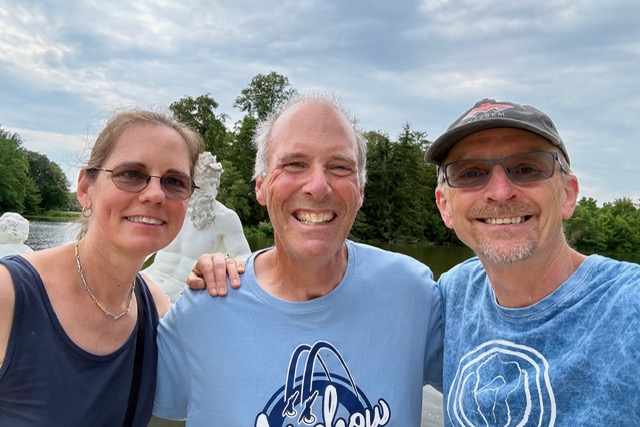
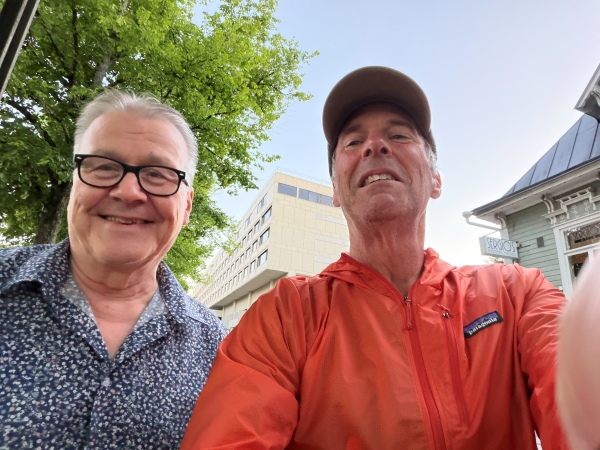
Tina, me, and Gunter, on the day we met.
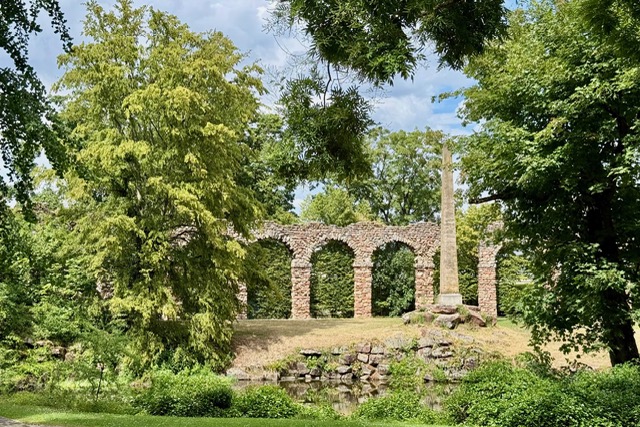
It looks like the ruins of a Roman aqueduct, but this scenery at Schwetzingen Palace was built in the 18th century and always looked like this. Photo courtesy of Tina Haug.
June 30 — Worms, Germany to Mannheim, Germany
Earthrounders befriend me; mechanics assist me
People who have flown around the world in an airplane are known as earthrounders, and they’re a pretty small group. As I was planning my trip, I got a lot of advice from those who had done what I planned to do, especially fellow Mooney pilots Brian Lloyd, Pieter Nel, and Tina and Gunter Haug. It is a friendly community of people who are more than happy to pay forward the assistance they received when they were planning and undertaking their own adventures.
Tine and Gunter made their trip in 2025. You can read all about it here.
I reached out to Tina and Gunter and asked if I could stop by for lunch or dinner as I made my way down to Austria for my marathon in Pitztal. Not only did they agree, but they also invited me to stay the night at their apartment near Mannheim. “Of course,” Tina said. “You’re an earthrounder.” “Not yet,” I said, “but I’m trying.” They met me on arrival, and after a bite to eat at the airport cafe we headed to Schwetzingen Palace, where the beautiful grounds include an 18th century fake Roman aqueduct ruin. We then feasted on charcuterie and talked about flying and flying adventures, and they gave me some pointers for the rest of my trip.
There was one thing Tina and Gunter couldn’t do for me: help me get my engine to perform a little bit better. It was acting as if there was a slight blockage in one of the four fuel injectors, thus requiring me to operate the others a bit rich (more fuel per unit air) to get that cylinder to run well (the necessary amount of fuel per unit air). Fortunately, I walked over to a hangar at Mannheim and found Dennis Deaton and Justin Black.
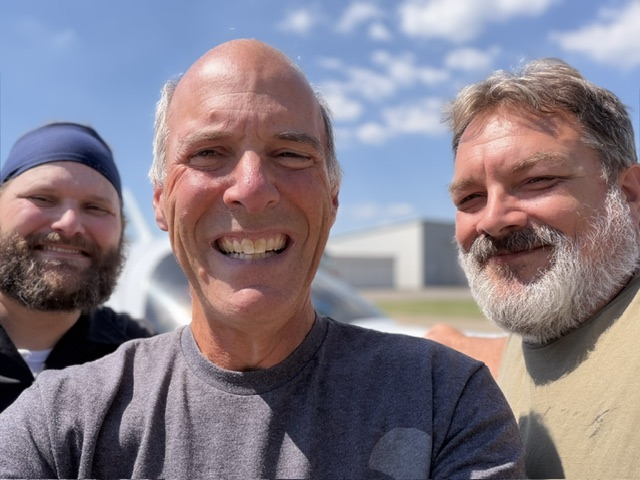
Justin Black, me, and Dennis Deaton at Mannheim Airport.
Justin and Dennis are veterans, aviation mechanics, and very friendly people. They got the partially blocked injector cleaned, and the plane flew perfectly. They were happy to contribute to making my adventure a success, and I was–and am–grateful for their assistance. Thanks, guys!
- june 29
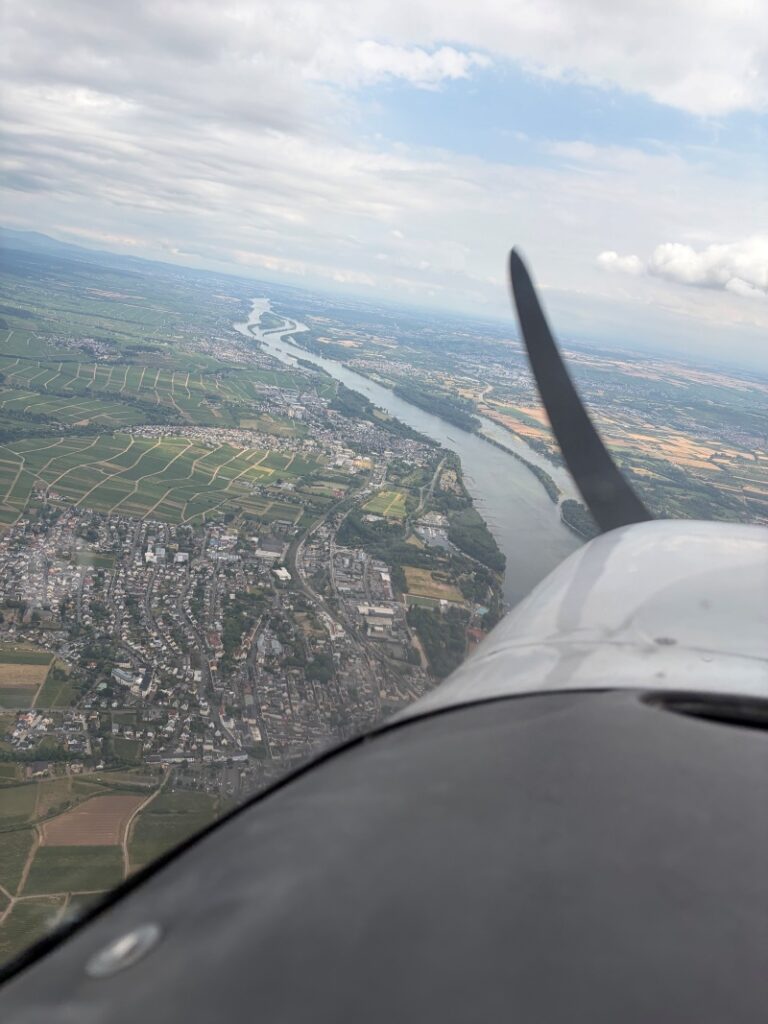
Flying down the Rhine.
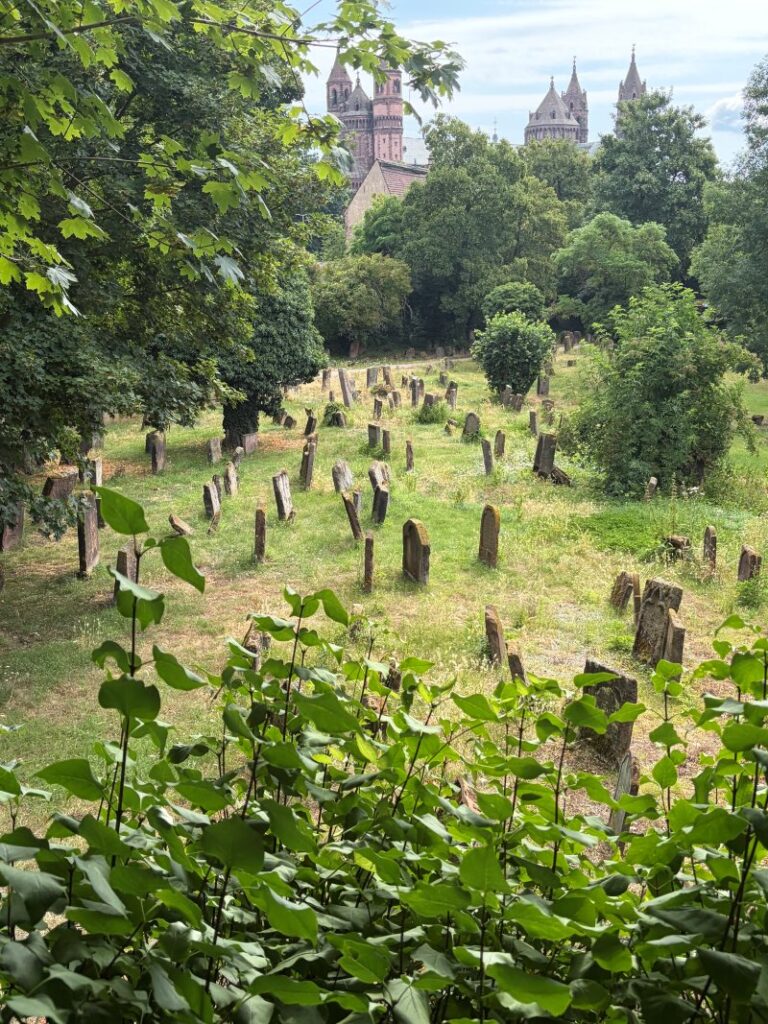
The Jewish cemetery in Worms has graves from 1058, making it the oldest surviving Jewish cemetery in Europe other than the Jewish sections of Roman catacombs. That’s the Worms cathedral in the background.
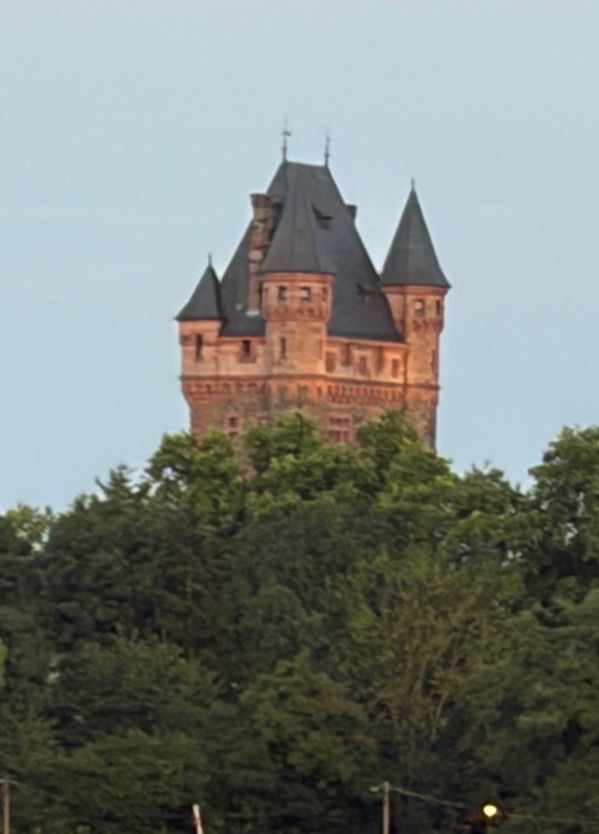
The Nibelung Tower is relatively modern, built in 1900, but it’s still picturesque.
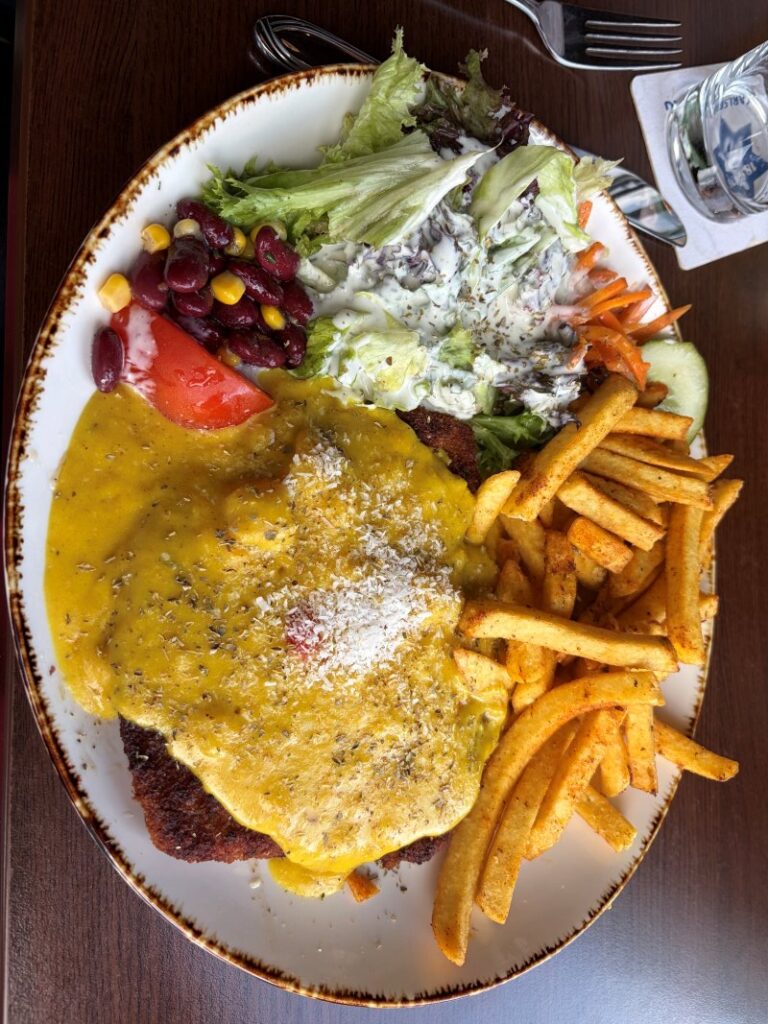
Schnitzel with Bombay sauce at Zum Propeller, the Worms airport restaurant.
June 29 — Aachen-Merzbrück, Germany to Worms, Germany
A good day for me, a bad night for Germany
I flew down the Rhine to Worms, famous for the Diet of Worms and the trial of Martin Luther. I usually walk or take public transportation to travel to and from airports; in Worms I rented a bicycle for a few euros. I managed to find my way.
Worms has a lot of religious sites: a famous cathedral, a large monument to the reformation, a nearly thousand-year-old Jewish cemetery that survived World War II almost wholly intact. It’s an interesting city to explore.
In the evening, I walked to a beer garden by the river to watch Germany play Paraguay in the World Cup. Germany trailed 1-0 at halftime, and I was tired enough I decided to walk back to my hotel. Germany lost in a shootout, and I got some sleep.
For food, I took hints from my environment. Germany has a very large Turkish population, so I ate Turkish food for lunch (from a bakery) and dinner. At the airport, I noted the Ganesh icon and the host’s background and ordered the Bombay sauce on my schnitzel. These food decisions worked out very well.
- june 27-28
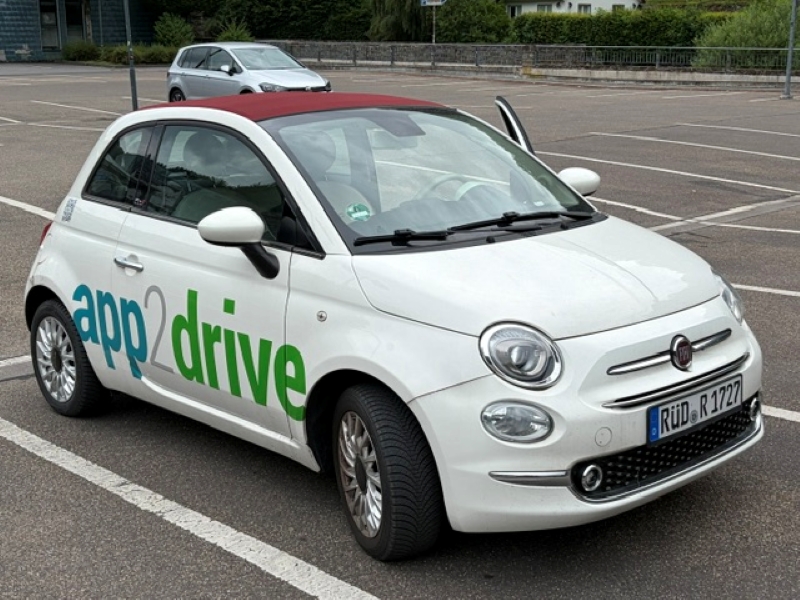
Once I figured out how to get it into reverse, this car worked great.
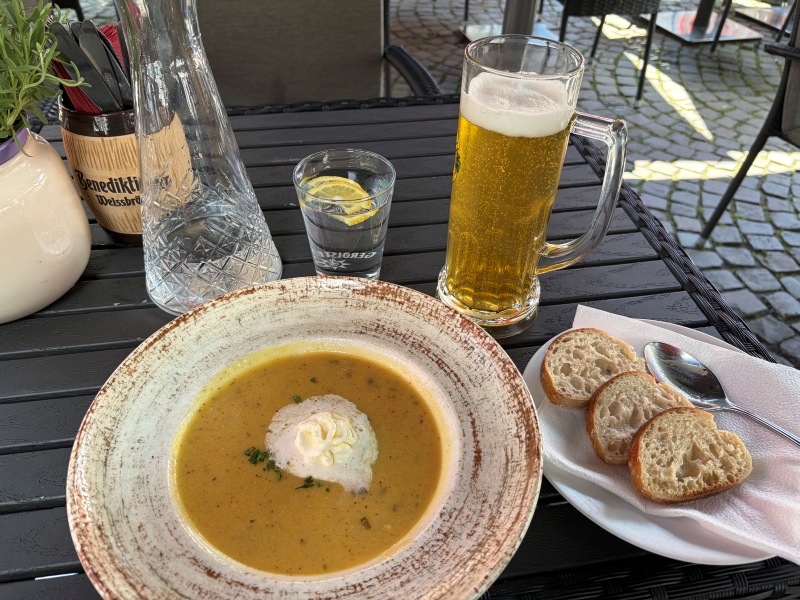
Mustard soup, a Monschau specialty.
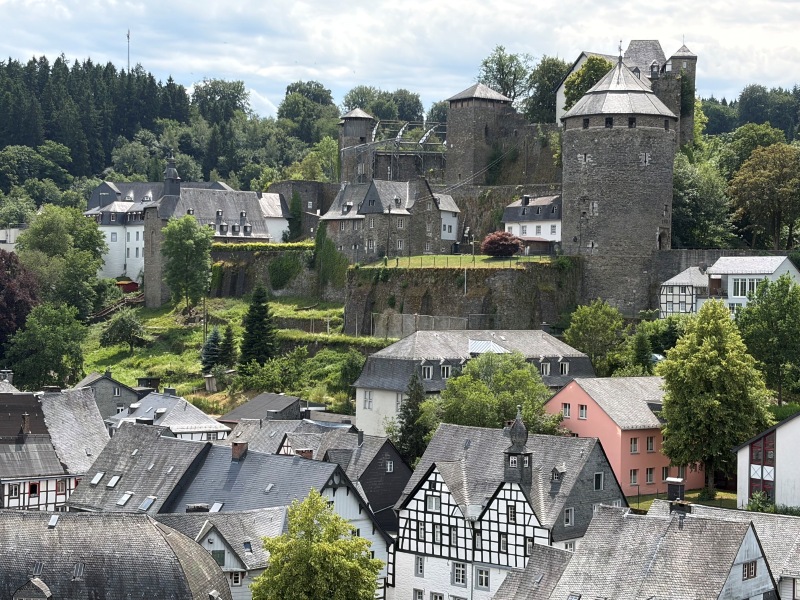
Monschau.
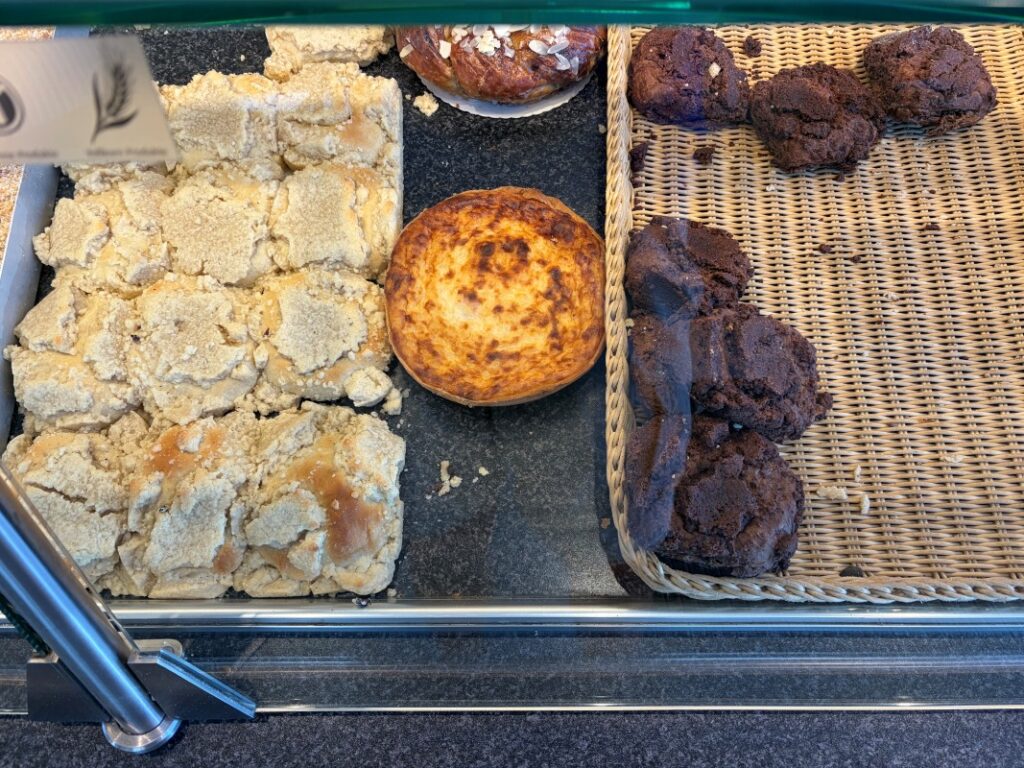
Streuselbrötchen, without or with chocolate, are an Aachen regional specialty. Which to have? One of each, of course.
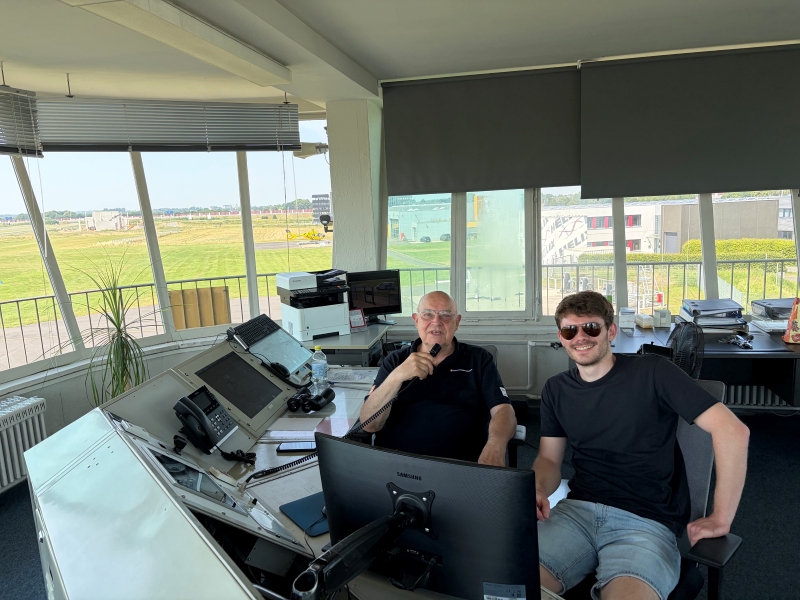
Aachen-Merzbrück tower was in good hands with Walter Pastucha and Nikolas Fischer. Walter has flown across the North Atlantic three times.
June 27 — Le Touquet, France to Aachen-Merzbrück, Germany
A half a marathon is better than none; also, visit Monschau
The best airport and hotel for the half-marathon in Sourbrodt, Belgium were both in Germany. On Saturday morning, I waited for some storms to pass and then headed to the airport for a 79-minute flight, with convective activity to the north but a safe and smooth ride for me.
At a general aviation airport outside of Aachen, I picked up my Zipcar-style rental from app2drive, and got going once I figured out how to shift into reverse (you have to lift on the collar of the stick shift). The little Fiat turned out to be the perfect size for the narrow roads of Monschau, a picture postcard town nestled in a valley a few miles from the Belgium border.
I finished second in my age group in 1:54:38 in the half-marathon at the Marathon des Hautes Fagnes. It was the longest trail run I had done, and I enjoyed the scenery as I ran through the hills of Belgium’s largest nature reserve.
- june 25-26
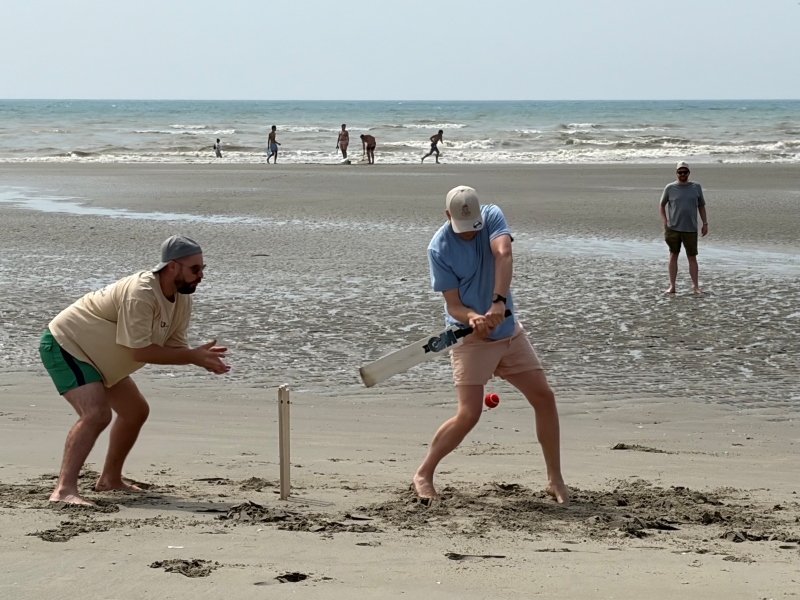
Le Touquet is a short flight or ferry ride from England, so there are lots of English tourists. And where you find Englishmen, you find cricket.
June 25 — Bergen, Norway to Le Touquet, France
Great flying weather; bad running weather
The crew of Ryanair Flight 7239 delivered their passengers safely from Manchester to Copenhagen on June 25, 2026. I delivered myself safely from Bergen, Norway to Le Touquet, France. Unbeknownst to the Ryanair passengers, one of the pilots gave me a hand. I was often too far from land for the controllers to hear me, even when I was at 10,000 feet. That’s when relaying the message through an airline pilot way overhead comes in handy. Thanks, Ryanair!
I had good flying weather: No storm clouds, few clouds at all, and freezing levels above my altitude. But the heat on the ground in France caused some problems. The evening I arrived, I received an email with the subject line, “Message de l’organisation : Annulation du marathon des Gueules Noires.” The marathon was cancelled because of the heat. Temperatures had reached 106 degrees Fahrenheit in Paris during the week, and people had died from the heat and from drowning while trying to escape the heat, so the entire country was in a panic. It turned out that the high in Saint-Amand-les-Eaux on June 28, the planned race day, was 81 degrees Fahrenheit, so the race should have been held.
Regardless, as of Thursday, I no longer had a marathon to run on Sunday. I scrambled to find a replacement and was overjoyed to discover a Sunday race in Belgium. The entry deadline had passed, but an email to the race director was sufficient to get me in. Problem averted. Or so it seemed. I changed my travel plans, canceled my hotel reservation for the first race and made a hotel and car rental prepayment for the new race.
Early Friday afternoon, I got an email. The second marathon had been cancelled, too, also because of the heat. Did I want to run the half marathon, instead? This was bad. I am not running 26 half marathons in 26 weeks in 26 countries. That would make no sense. A half marathon is 13.1 miles; 26 doesn’t really come into it. But after exploring other alternatives, I decided to run the half. I’d already made nonrefundable arrangements, and at least I’d get some exercise. I found a marathon in Scotland that I could enter a day before my marathon on the Isle of Man, meaning I could still run 26 marathons in 26 weeks in 26 countries, just not one a week.
- june 23-24
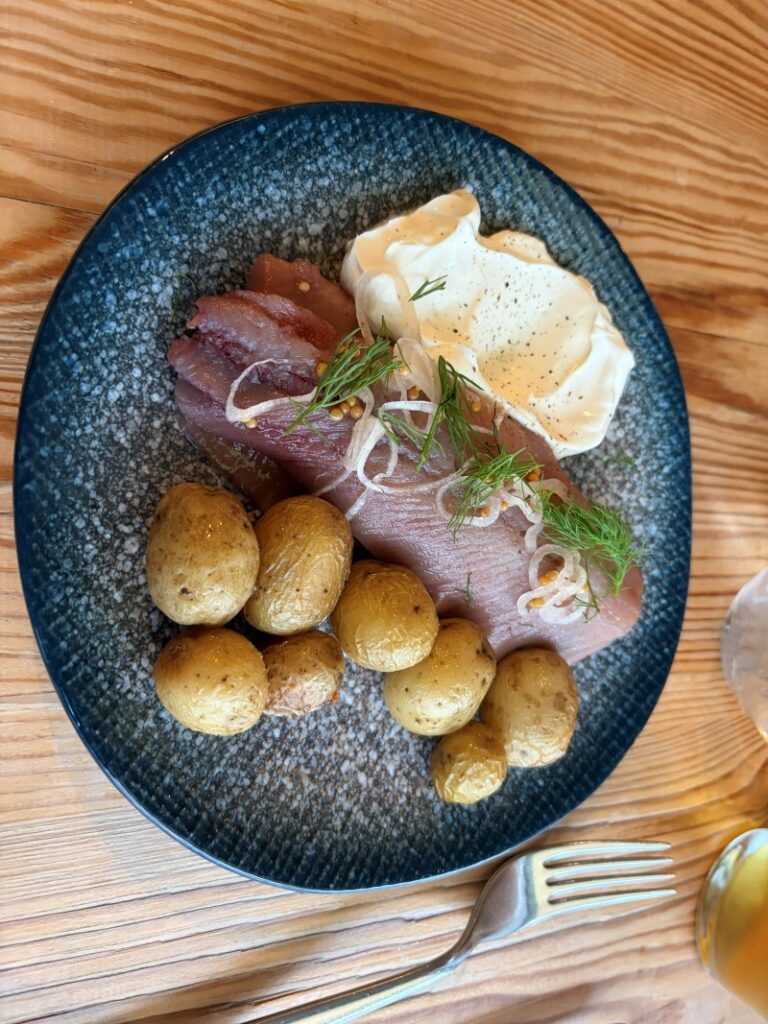
Herring with potatoes and sour cream at marg & bein, where I also enjoyed the plukkfisk with bacon.
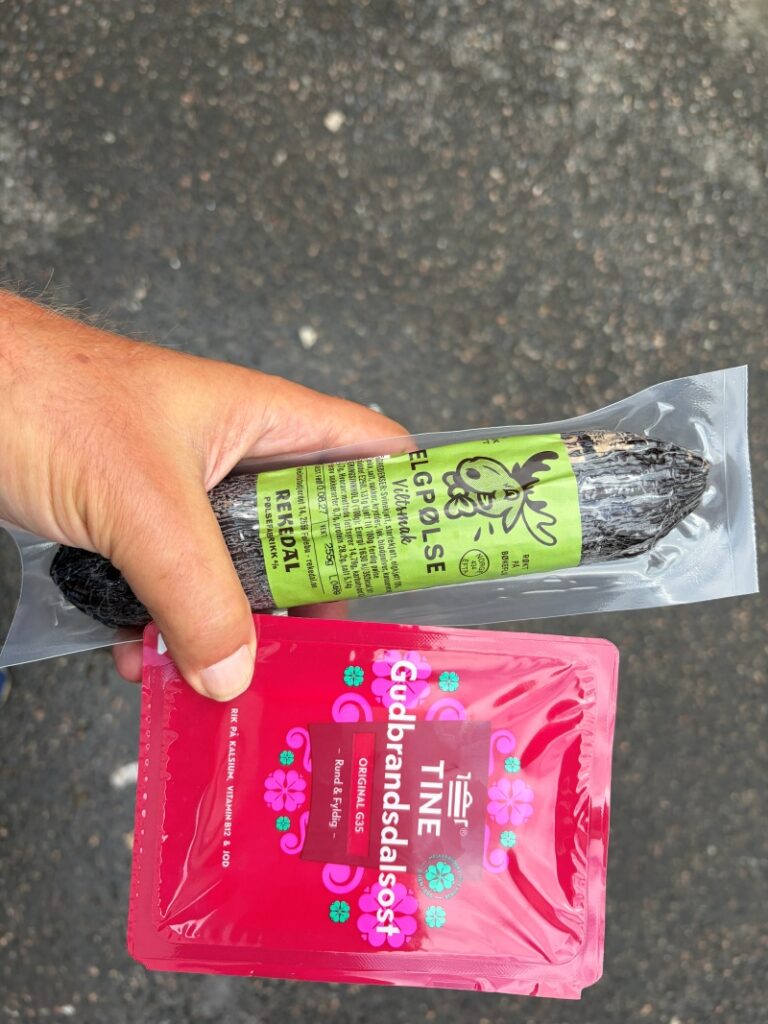
Elk sausage and my favorite Norwegian cheese, a brown cheese that tastes like caramel and is made from goat and cow’s milk.
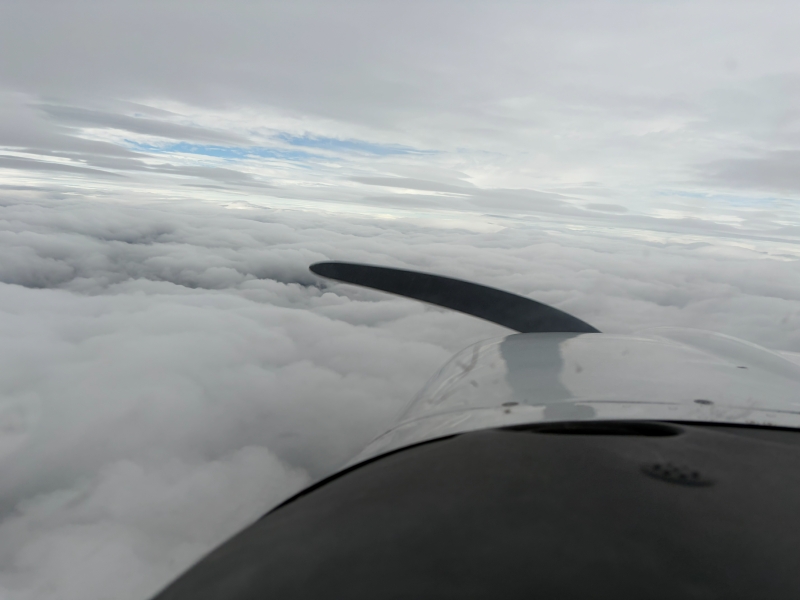
Holding outside Bergen.
June 23 — Kjeller, Norway to Bergen, Norway
Holding en route to the coast
Learning how to fly holding patterns is a required element of getting an instrument rating, and logging at least one hold every six months generally is required to stay current i.e. able to use your rating. But actually flying a hold outside of the training environment is very rare. So I was surprised when air traffic control instructed me to enter a holding pattern as I approached Bergen.
Bergen’s airport has one runway and a lot of airline traffic, and I had the misfortune of arriving at a time when a lot of airliners were coming or going. I ended up holding for 30 minutes; in the 30 minutes before I landed, six Widerøe (a Scandinavian regional carrier) flights landed, as well as a KLM flight from Amsterdam and a CityJet flight from Copenhagen, and there were, of course, departures, too.
It’s also possible the controllers forgot about me after I entered the hold. Things happen. Anyway, this isn’t a complaint. The controllers are very good, and weaving a less predictable and slower airplane flown by a private pilot in amongst the airline traffic is not an easy job. I helped out by keeping my speed up as long as possible once they freed me from the hold to fly the approach.
Bergen is a lovely city, with the highlight being the colorful buildings used by the Hanseatic League, a confederation of guilds that dominated northern European sea trade from the 13th to the 15th century. Another highlight, for me, was the food (see photos).
One underrated place to meet people while traveling is the laundromat. It’s easy to start a conversation when somebody is helping someone else figure out how to use the machines. I met a group from Sun Valley, Idaho who were doing a bicycling trip; they hadn’t brought their own bicycles, but they had brought their seats and pedals.
- June 22
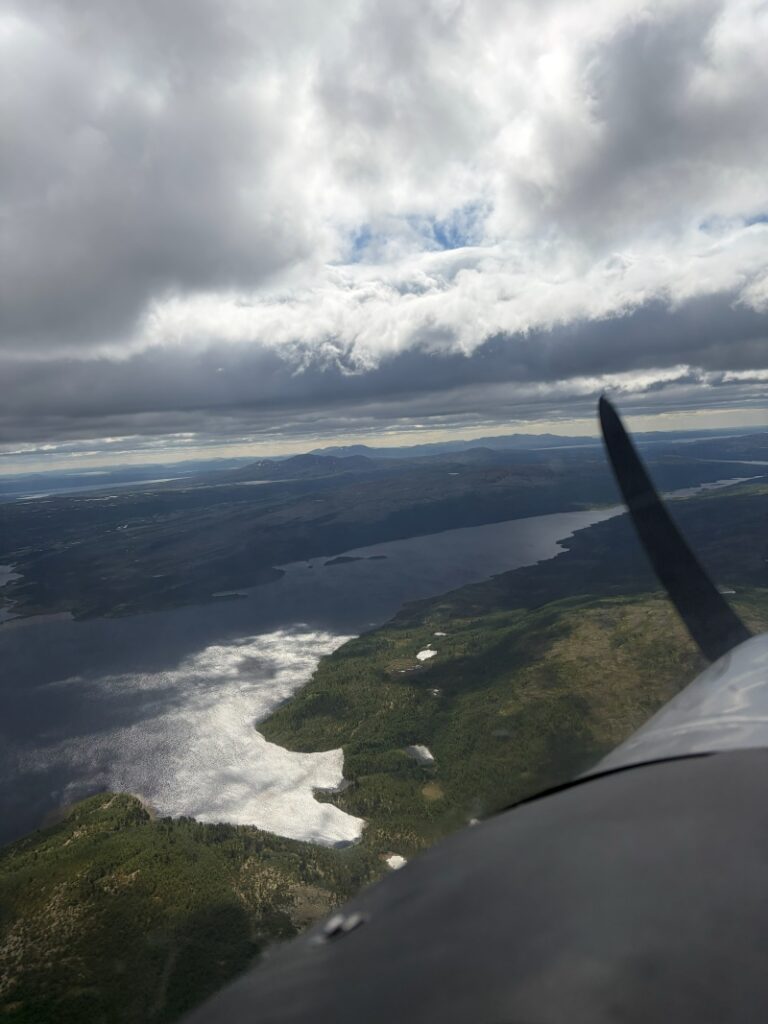
En route to Kjeller, over a lake and under some clouds.
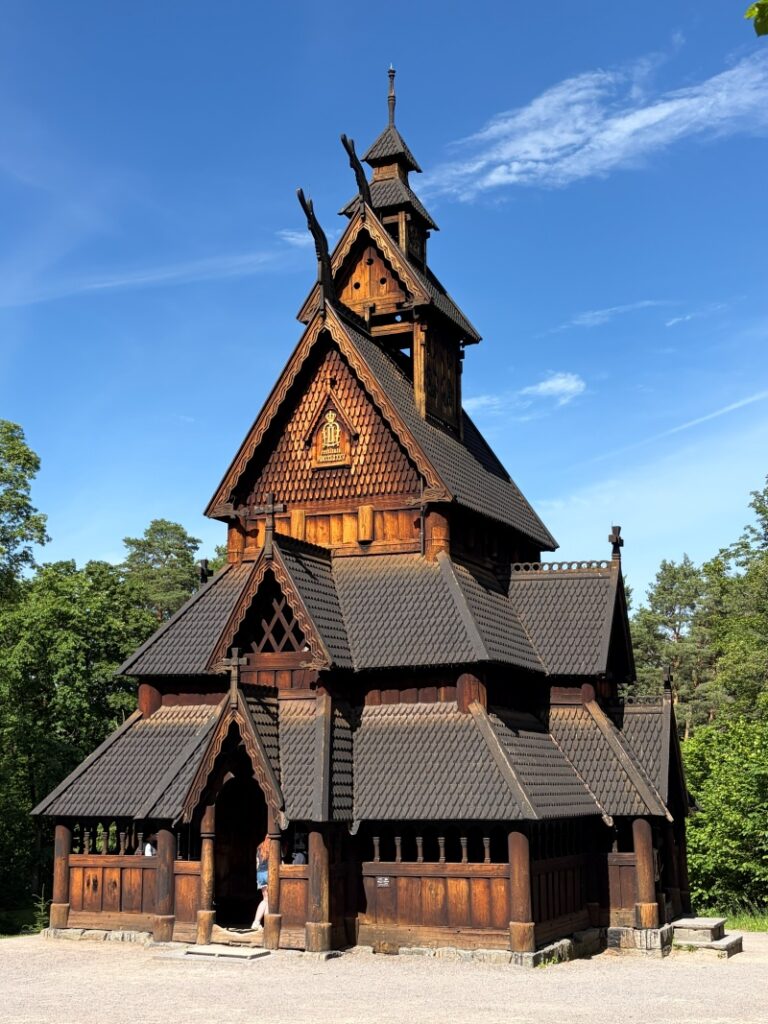
A 19th century renovation of the 13th century stave church from Gol, Norway, at the Norway Folk Museum.
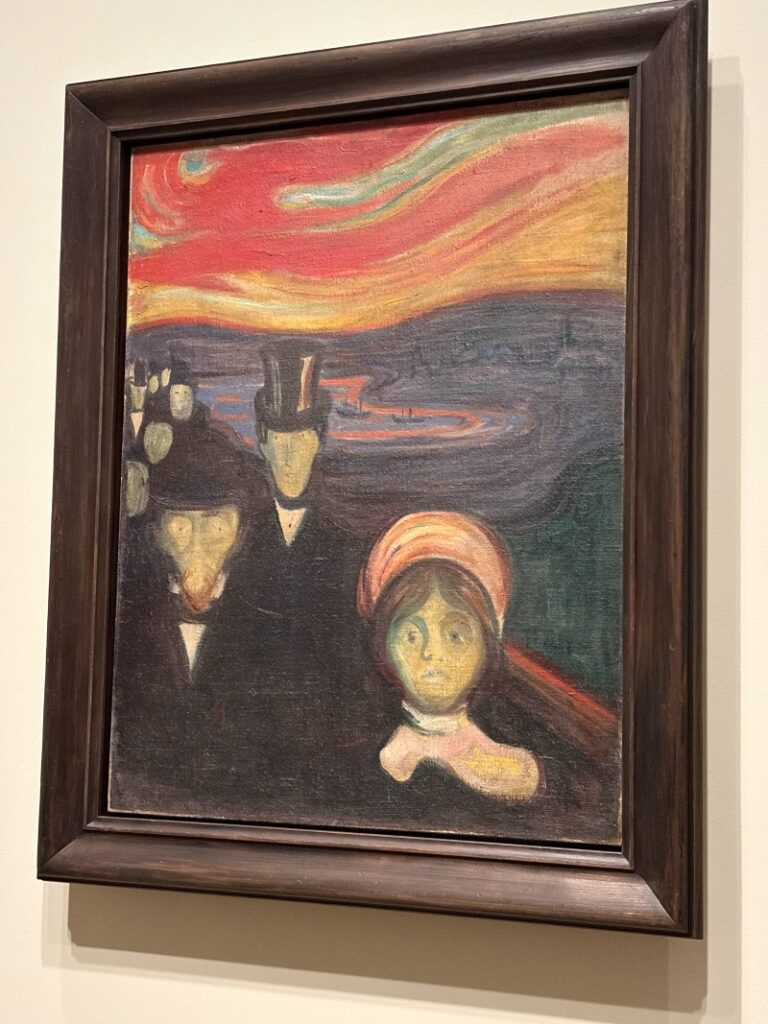
“Angst” isn’t the most famous painting by Munch, but it’s a good one.
June 22 — Røros, Norway to Kjeller, Norway
Exploring Norway’s capital city
Oslo has a wonderful general aviation airport in a suburb called Kjeller. It’s a part-time military base, but when the military isn’t active it operates much like most US airports, with no control tower and pilots communicating their intentions in the blind on a common traffic frequency. There’s a bus stop just across the fence from where you park your plane, and the connections into Oslo are good.
It’s a visual flight rules airport; my job was to avoid restricted airspace and stay underneath the ceiling of the controlled airspace for Oslo, while maintaining the required distance from clouds and terrain. It gave me a fair amount to think about, but it wasn’t that difficult.
After checking into my hotel, I had time for a couple of museums. The Norwegian Folk Museum is excellent, especially its outdoor portion, where buildings from various towns and municipalities are on display. Reenactors do folk dances and play instruments and blacksmith and do woodwork and reenact other historical tasks. Then I headed off to the museum known simply as “Munch,” which consists of multiple floors of work by Edvard Munch and a couple of exhibits of work by others.
The Norway-Senegal game was scheduled for 2 a.m. Norway time, too late for me, but not for a large percentage of Norwegians; while I walked back to my hotel around 11 p.m., I encountered many people dressed in Norway jerseys and heading to or getting started with World Cup watching parties.
- june 21
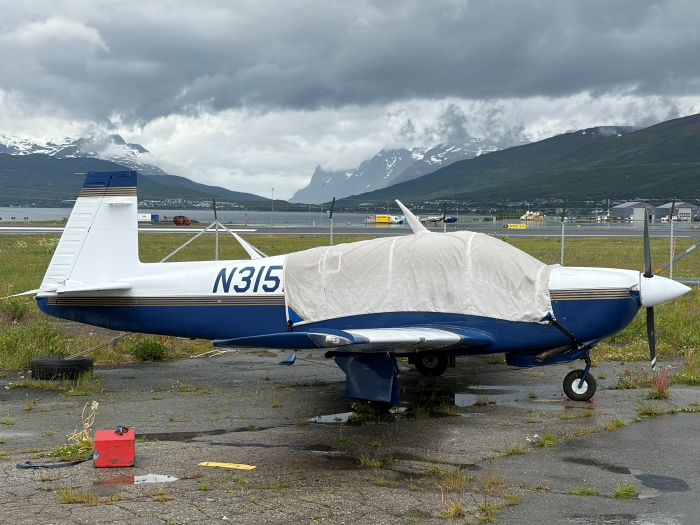
The weather on the day I left Tromsø was a little bit challenging, as you can see from this picture of my parked plane . . .
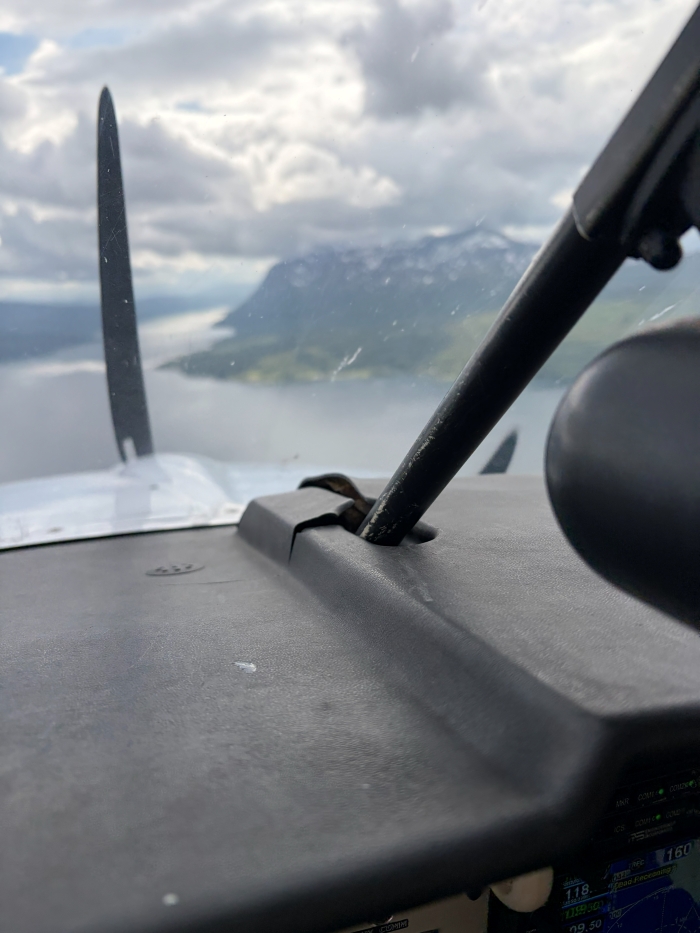
. . . and this shot shortly after departure.
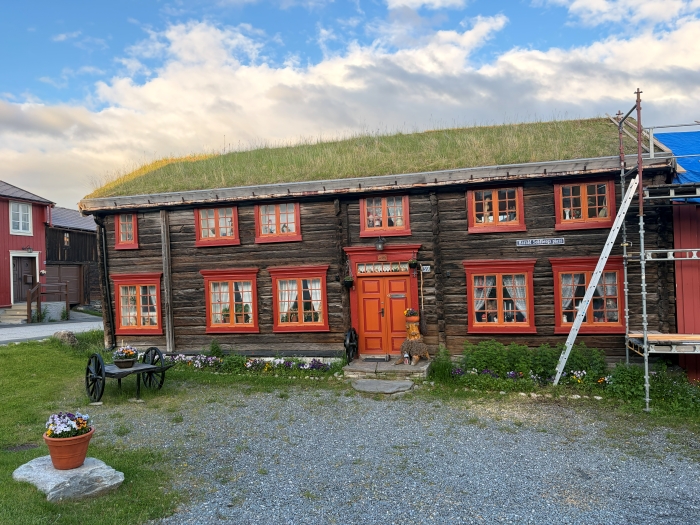
A black wood house in Røros.
June 21 — Tromsø, Norway to Røros, Norway, via refueling stop at Bardufoss, Norway
More new friends, and a nice small town
Heading south the day after the Midnight Sun Marathon was supposed to be a scenic flight down the coast toward Bergen, but the weather didn’t look good for scenery along the coast, with low clouds creating some potential challenges. Yes, I could fly low over the water just off the coast, but there was a risk that the ceiling would drop in places and leave me with no good options, other than turning around.
So I called an audible and chose an inland destination and a visual flight inland, where the clouds were supposedly higher and scarcer, with a clear bail-out area to the east in Sweden. In fact, my route took me inland enough that I was over Sweden for much of the flight, after a refueling stop at nearby Bardufoss, because Tromsø lacked avgas. (Avgas scarcity can be a major issue when flying outside the United States, and as a US-based pilot you have to force yourself to think about it when planning.)
The inland route turned out to be no walk in the park. It was more like west Texas turbulence, with some challenging low clouds that made me deviate to the east and, in one situation, make something close to a U-turn. Winding through mountains at low altitude while bumping along gets a bit tiring; I was happy when I reached Røros, an old copper mining town that is a UNESCO world heritage site for its more than 2,000 preserved wooden 17th-century houses with blackened façades. I was even happier when Nils and Ingrid met me at the airport, introduced themselves, and gave me a lift into town and hotel and restaurant recommendations. Nils owns a turbo Mooney based at Jönköping, Sweden, where I just happen to be scheduled to run a marathon the last weekend in August. Small world.
- june 18-20
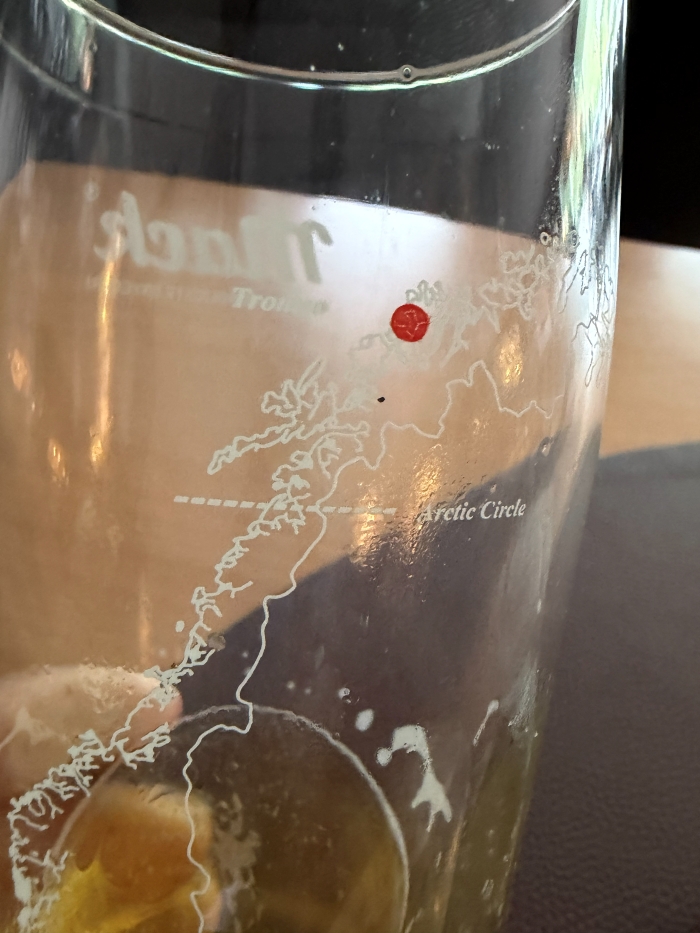
Mack, the world’s northernmost brewery, was founded by Ludwig Markus Mack in Tromsø in 1877; I drank some of its beer in 2026.
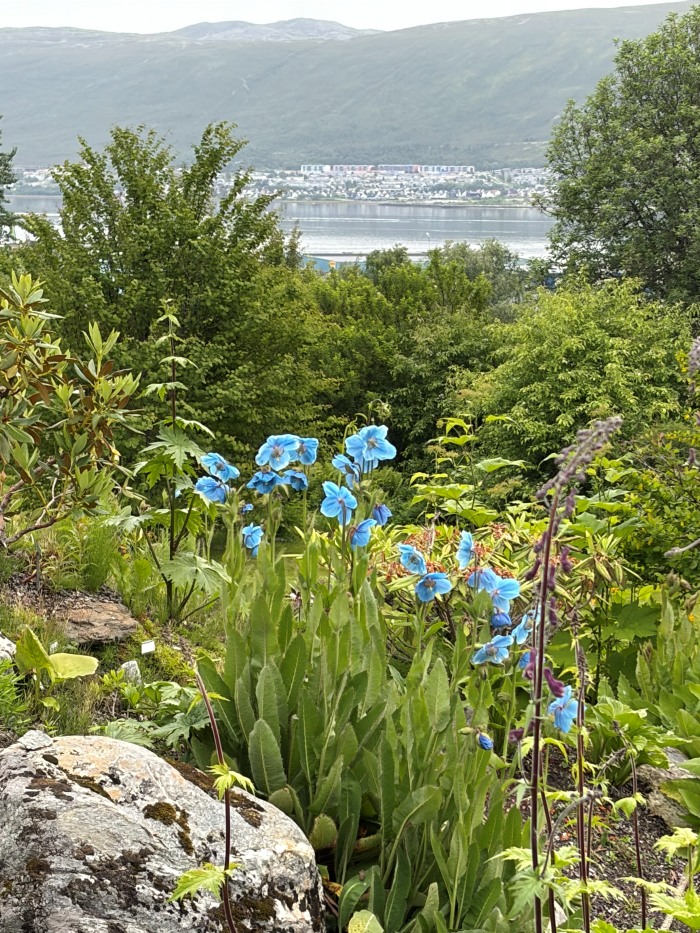
Flowers in the world’s northernmost botanical garden, with the fjord behind.
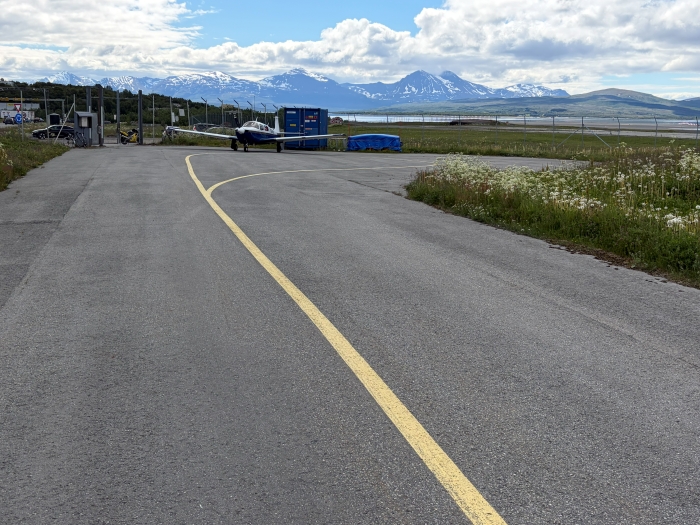
The dead-end taxiway with the two-hour parking limit.
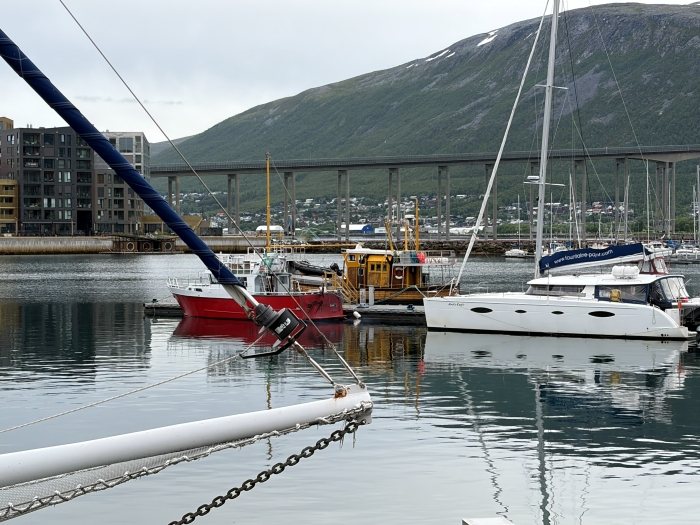
Tromsø’s harbor, the bridge we crossed twice in the marathon, and the mountain across the fjord.
June 18 — Turku, Finland to Tromsø, Norway
My northernmost flight of the trip
Tromsø, Norway, is at 69°39′06″ north, slightly farther north than Ilulissat (69°13′11″). When I got there, I walked past the world’s northernmost traffic light and visited the world’s northernmost botanical garden. I have been farther north in my plane; I once landed at what was then known as Barrow (71°17′26″). But I’m not going any farther north on this circumnavigation.
One way to think about how far north Tromsø is: It’s farther north of Los Angeles than the distance between Los Angeles and the equator. One way to think about how big the arctic is: Tromsø is still 1,367 miles from the North Pole. In other words, if I had taken off from Tromsø and headed due north, in still air, I would have taken more than eight hours to reach the pole.
My original plan was to fly to Tromsø on Saturday, the day before the Midnight Sun Marathon. But Tromsø is surrounded by mountains, and I had concerns about whether the weather would cooperate with my flight. Better to go a day early and be more confident of arriving, with an added day of time if something unexpected popped up. After I changed my plan, the Friday forecast got a bit worse, too, but there was still a way to get where I wanted to go if I cut over to the west coast of Norway and then worked my way northeast along the coastline. It wasn’t the shortest route, but it gave me the best chance of success.
Things went well for most of the flight, as I was able to stay below the freezing level and therefore able to penetrate clouds en route. But when I first contacted Tromsø air traffic control, I got an unpleasant surprise. The controller asked if I had arranged parking and said I could spend just two hours on the ground at Tromsø if I had not done so. I had a “slot reservation,” through an unpleasant overly bureaucratic process required by many Norwegian airports, including Tromsø. But I knew nothing about a requirement to arrange parking. And the website of the operator of the airport, Avinor, said the following:
“All private and small aircraft are welcome at Avinor’s airports. We offer parking for GA flights (General Aviation). No one knows the airside better than Airport Patrol, which offers escort services to the parking stands and transport to and from the terminal when needed. . . . Parking for aircraft under 2730 kg is free.” (Emphasis added.)
But you don’t start a debate with an air traffic controller while flying your plane. I considered diverting to my alternate airport, from which I could find another way to Tromsø. But I had plenty of fuel and was almost at my destination. Better to land and try to find a way to stay longer than two hours.
Jari had warned me of the steep glide path at Tromsø, and I soon found out he wasn’t kidding. Generally, planes descend on a 3% slope when approaching an airport. The instrument landing system for runway 36 at Tromsø has a 4% glidepath. It’s like staring down a very steep staircase with the runway at the bottom. I used my speed brakes to help me descend fast enough without picking up too much airspeed, and everything went fine.
I was instructed to taxi to a taxiway that was like a one-lane dead-end street with a circle at the end, where two pilots in RVs were waiting for me to taxi in so they could taxi out. I shut down the engine and started Googling for someone who might offer me a place to park for more than two hours. Emails got no immediate response. I decided to call the tower to ask for help.
Fortunately, a pilot associated with the local flying club heard me. The tower gave me his number; I called, and once he landed from a sightseeing flight about 10 minutes later he arranged for me to rent a parking place controlled by Tromsø Flyklubb. It cost me $162.26 for three nights, but that was a lot better than having to park at another airport and find my way to Tromsø via bus.
The Midnight Sun Marathon started at 8:30 p.m., which meant I carb loaded in the morning by eating a lot of bread and pastries. It’s a lovely course over a bridge, along a fjord, turning around, over the same bridge, back through town, go about 5k more, turn around again, and return to town for the finish. The bridge was the only serious hill, not exactly like the Verrazano Narrows Bridge in the New York Marathon, but somewhat reminiscent.
I ran much of the last 15 kilometers with Marco Carradore from Milan, who once lived in Orange County, California. Marco was trying to break four hours for the first time. I worried that he was going too fast but obviously didn’t tell him that; I just suggested he stay relaxed and not push too hard and he had sub-4 in the bag, as he was well ahead of a four-hour pace. He finished in 3:55! I came in at 3:56:54, again achieving my sub-four-hour goal for road races. It later turned out that because of a mistake in placing a pylon the course was 140 meters short; I’m counting it, anyway. I certainly walked more than 140 meters after the finish, and my walking pace would still leave me under four hours for the marathon.
- june 17
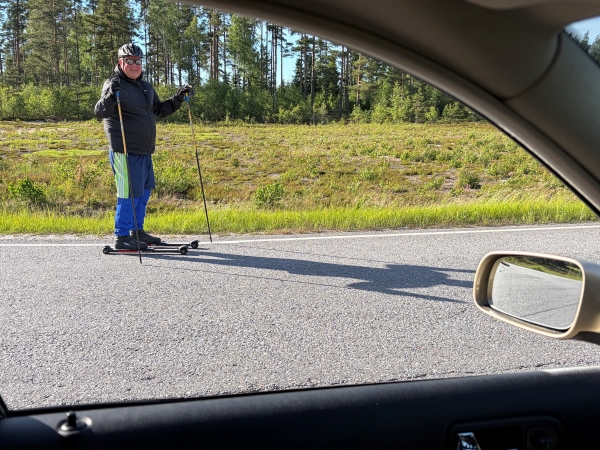
What I saw out Jussi’s window on the ride into town from Turku Airport.
Unlike the first time we met, there was no fence between Jussi and me when we went to dinner in Turku.
June 17 — Hyvinkää, Finland to Turku, Finland
Getting back together with Jussi
I woke up to find I had slept until noon, but the hotel was kind enough when I checked out 20 minutes late. It was raining, and there were low clouds. This wasn’t good, as Hyvinkää is a visual flight rules only airport, meaning I needed better weather to leave. Fortunately, the forecast called for improvement.
With my umbrella and a light jacket, I didn’t get very wet on the four kilometer walk to the airport, where I waited for the low clouds to clear. Eventually, they did, and after a few hours of waiting I took off at 4:27 p.m. Forty-four minutes later, I was back in Turku.
Partly because of my uncertain arrival time, I had told Jussi I would take a bus from the airport into town. But his wife tracked me on flightradar, and when I landed he was there to meet me. He dropped me at my hotel, and I took a walk along the Aura River, which I crossed on a bridge and re-crossed on a free ferry that takes about 90 seconds. On my way back from Turku Castle I took the automated Kakola Funicular, also free but also short. Jussi and I returned to the river for an excellent dinner, and I drank a couple of lonkeros, Finnish cocktails made from gin and grapefruit juice.
- June 16
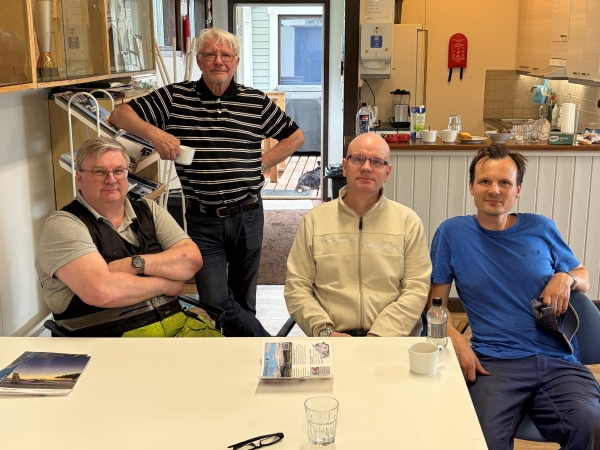
Members of Jukolan Pilotit ry, the flying club at Hyvinkää airport.
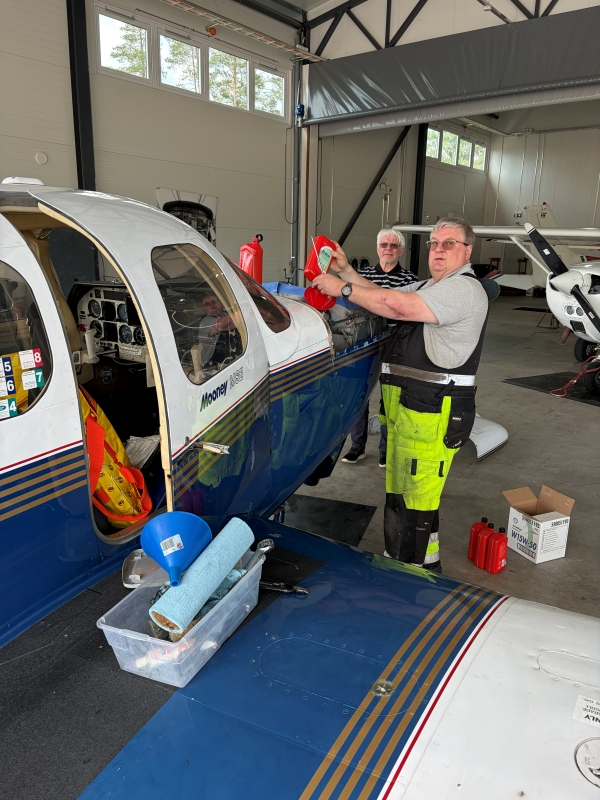
My intention was for me to do the oil change, but Pertti Heininen gave me a big hand.
June 16 — Forssa, Finland to Hyvinkää, Finland (after bus back to Forssa from Helsinki)
Changing the oil, meeting more friends
After taking the bus back to Forssa from Helsinki, my plan was to catch a cab to the airport, but it was a nice day and it was only about 4 kilometers, so I walked. The flight from Forssa to Hyvinkää took less than 25 minutes, and my biggest concern was glider activity. Fortunately, I didn’t encounter any.
Hyvinkää is a very active general aviation airport almost due north of Helsinki, with a flying club and a glider club. The flying club showed me great hospitality. Jorma (on the right in the top photo) helped arrange my oil change. Pertti, the mechanic, (on the left in the top photo) not only let me use his oil bucket but also let me use the hangar and helped me with the oil change. It turns out that Pertti owns a beautiful Mooney, reportedly the only one registered in Finland. He also owns a Yak, a rare World War II era Russian plane. He showed me both. Pertti was planning to head to Oshkosh, Wisconsin in July for Airventure, the huge aviation get-together, and he was going to fly in in a US-owned Yak. I’m not the only one who has flying adventures!
There was only one problem. When I tried to use my credit card at the fuel pump, it asked for a PIN. My credit card has a PIN, but I’ve never used it and don’t remember it. I had an idea. I’d go into town and get cash from an ATM, use one of the Finnish pilots’ credit cards for the fuel, and repay that pilot in cash. Jari, the airline pilot I had met in Forssa, gave me a ride into town to the ATM, and I withdrew a lot of euros. Then I got an idea. Maybe I could use my ATM card, which is a debit card for which I know the PIN, to pay for the gas. That worked.
After my oil change, Jari drove me to a hotel to drop off my bags, then took me back to Helsinki to show me around. We went for a walk along the shoreline, saw some sights, and then had a wonderful Finnish dinner at Ravintola Zetor, where I enjoyed the liver with lingonberries, plus a dessert of “squeaky cheese” stewed in caramel cream served with cloudberry jam. Squeaky cheese, leipäjuusto in Finnish, isn’t exactly like squeaky cheese curds you find in Wisconsin, but it’s a close cousin. Jari dropped me off back at my hotel after a very good, productive day.
- June 14-15
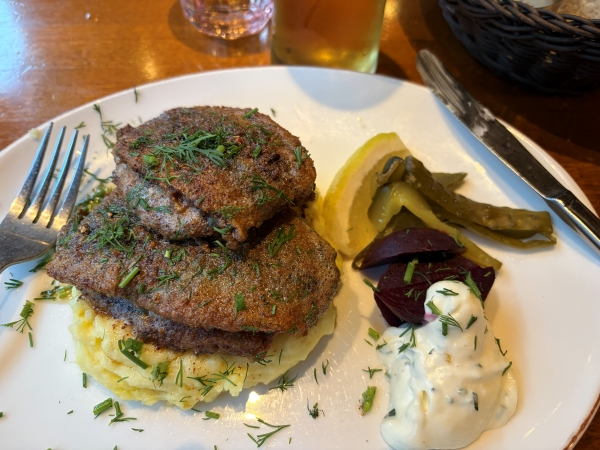
June 14 — Forssa, Finland to Helsinki, Finland, by bus
Exploring Finland’s capital, and a sauna
It takes about two hours to travel the 120 kilometers by bus from Forssa southeast to Helsinki. Over the next couple of days, I walked all over town, did my laundry, and ate local food. The picture above is what the menu at Ravintola Kannas calls Finnish Way of Living. It’s “fillets of Baltic herring filled with onion and dill, mashed potatoes, beetroot, pickles and aioli.” It’s excellent.
My hotel had a sauna. I had never been to a sauna before. So I went. I had read about what to do. You shower. You go into a hot room. You sit. You don’t talk. You sit some more. There was one guy who arrived at about the same time I did who looked like he knew what he was doing. He sat on one side of the sauna. I sat on the other. Both of us were naked, each sitting on a towel on our wood benches. Then, another guy came in. He looked uncomfortable. He kept a towel wrapped around him. After a while, the first guy left. There’s a bucket with water and a ladle for putting some water on the fire to create steam. I had read that you’re supposed to ask others before adding water. So I gestured to the water, and the guy gave a non-commital response that I read as an “I’d rather you didn’t.” So I didn’t. The heat in the sauna was somewhat soothing and relaxing, but I didn’t feel anything special. About 15 minutes after I entered, I exited, showered again, and got dressed.
- june 13
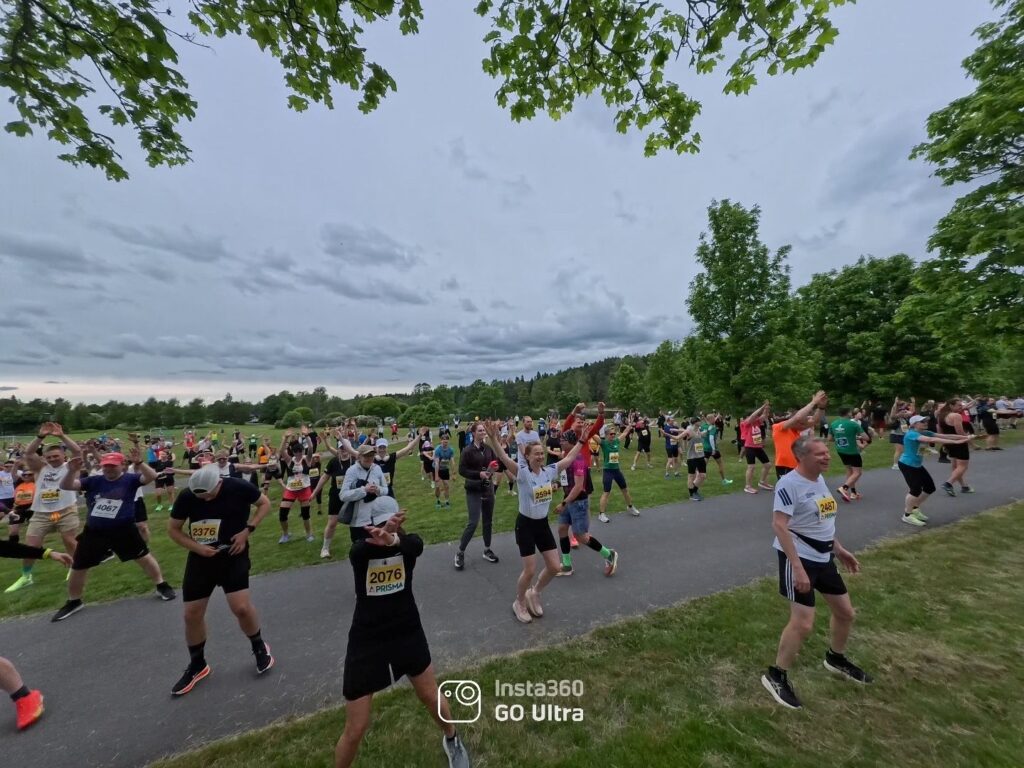
June 13 — Forssa, Finland
My first marathon outside of the United States
The Forssan Suvi-ilta, literally, Forssa Summer Evening, starts at 3 p.m. just outside a hockey arena a short walk from my downtown hotel. After I get my race number, I wander toward the start line. Much to my surprise, several minutes before the start, energetic music starts playing and two women lead a large percentage of the runners in pre-race calisthenics. Before a US marathon, runners do their own warmups, some stretching, others going for a short, slow run. Sometimes, in the leadup to a US race, the PA announcer will get a lot of the runners to wave their arms in the air and/or clap and cheer. This was entirely different.
Not everybody participated, so I didn’t feel awkward about not taking part. I saw a pace group that said 5:00, and since I was planning on running a 3:50-something marathon, I figured I should move closer to the start line to be with the faster runners. And then we were off, and in the rush of everybody around me, I realized I was running too fast.
There were no mile markers, of course. The rest of the world is generally metric. Calculations told me I should be going about 5 minutes, 45 seconds per kilometer. When I spotted the 3 kilometer marker, I saw that I was running sub-5. I slowed down, although not enough, and among the people who passed me were that 5:00 pace group. In the US, pace groups are based on finish time. Apparently, here, the pace group was minutes per kilometer. Live and learn.
The flat course quickly took us into the countryside. Temperatures were in the low 60s, and the drizzle turned into a light rain and back to a drizzle. Perfect running conditions. But the too-fast start hurt me, and by the time I was finishing the first of two 21-kilometer laps I knew this wasn’t going to be my most comfortable run.
I met a father-son pair from Boston and Texas (the son had just graduated from Rice), and they were looking strong. I met a woman from London. And I persevered. I held on for a 3:57:15, meaning I was now 2 for 2 on my target of running the road races in less than four hours. But I had to work for it.
- june 12
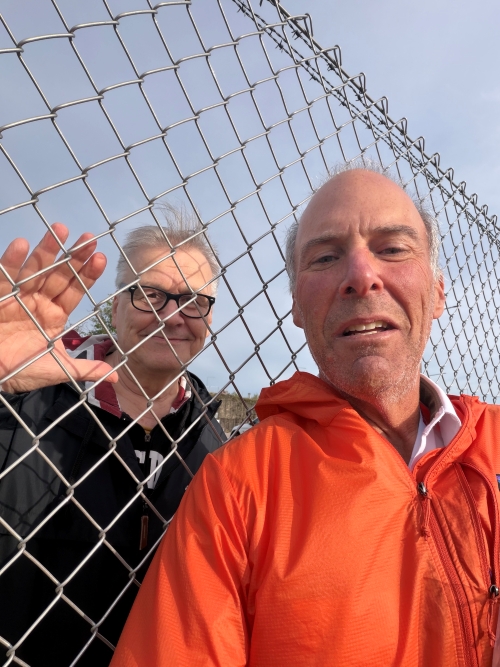
Jussi and me at the Turku Airport fence.
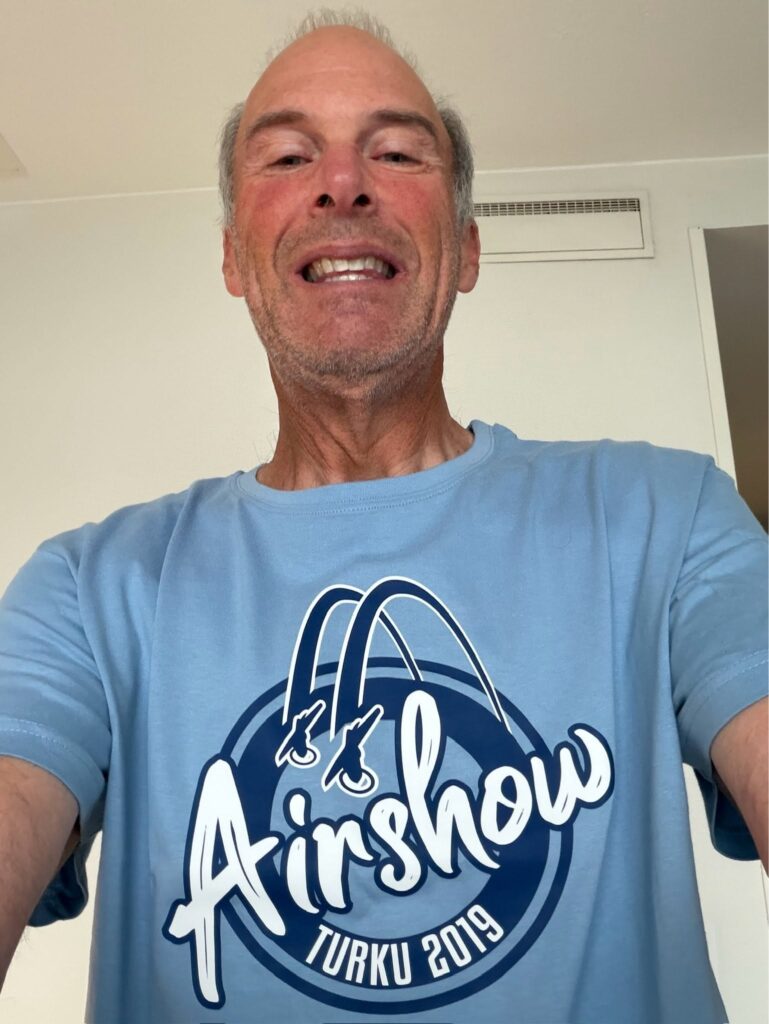
The T-shirt I received from Jussi. 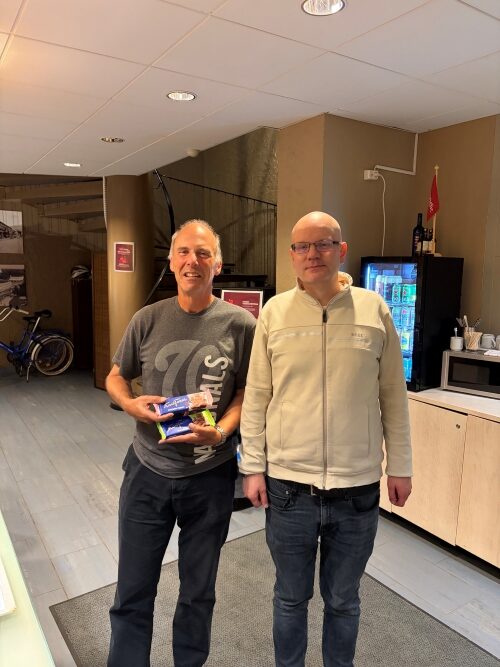
Me, Jari, and the Karl Fazer chocolate bars he gave me. June 12 — Vagar, Faroe Islands to Forssa, Finland
Meeting new friends in Finland
I would have loved to spend another day in the Faroe Islands, but it was Saturday and I had a marathon on Sunday in Forssa, which is 981 miles away as the crow flies. I couldn’t fly as the crow flies, though. There are mountains in Norway, and their peaks were above the freezing level, and there were clouds below the freezing level stretching high above the mountains.
I needed to find a route that would get me south of the mountains and that would be validated by Eurocontrol. In the United States, flight planning is much easier. In Europe, you have to comply with a lot of rules. Fortunately, there is software that helps. But it’s not perfect. I ended up solving my problem by telling a white lie to the software; I told it I was going to a spot in southern Norway, and then I told it I was going from that spot to the place I would clear customs in Finland, and then I joined the two routes into one that Eurocontrol would accept.
On departure, Faroe air traffic control warned of moderate turbulence, but fortunately the turbulence didn’t hit until I was well clear of the ground, and it was brief. Another problem. I was flying low, at 5,000 feet, and Faroe air traffic control was having a hard time getting Scotland to accept me at that altitude. I explained that I couldn’t go higher because of icing. Finally, the controllers worked things out.
Almost seven hours after departing Vagar, I landed at Turku, Finland, where I was soon greeted by three Finnish immigration agents who asked me the typical why are you here and how long are you planning to stay questions. My answers left them surprised, amazed, and amused. When the immigration agents left, I walked over to the terminal to handle my landing fee, but all of the doors were locked. As I was walking back to my plane, I heard a man calling my name. I didn’t know anyone in Finland, so this was quite a surprise.
The man calling my name had a camera and was standing on the other side of the airport fence. I walked over to him, and he introduced himself as an aviation enthusiast who had spotted my flight on flightradar24.com. He wanted to see the Mooney and the Mooney pilot that had flown from Vagar to Turku, and before that from Santa Monica across to Vagar. His name was Jussi Lempiainen, and he had presents for me: a Turku airshow T-shirt and a “Remove Before Flight” keychain. Five minutes in Finland, and I had a new friend. We talked for awhile, took some pictures, exchanged contact info, and said farewell.
I headed back out on a short, visual flight rules flight to Forssa, site of my marathon the next day. I spotted the town but didn’t see the airport, which has very little infrastructure and a single runway that’s only 50 feet wide. I had set up to fly a left downwind, which means I should have seen the airport on my left, but when my GPS showed me I was past it I turned left and headed back. That left turn was a perfect base leg, and the field immediately came into view. Shortly after I landed, taxied to the apron, and pushed my plane back into a space adjacent to the hangar, I was greeted by another new friend. I had “met” Hannu Hakkinen on euroga.org, a website for European general aviation (nonairline) pilots, and he had shared information about the Forssa airport and flying in Finland. Today, he had driven 60 kilometers to meet me in person and give me a ride into town. Hannu also showed me inside the hangar (and introduced me to another pilot) to look at some of the impressive planes based at Forssa.
And I wasn’t done making new friends. As Hannu was showing me around, two guys drove up. They’d seen the Mooney coming in and wanted a closer look. One of them was an airline pilot. Jari Leppänen flies ATRs for Nordic Regional Airlines, based out of Helsinki. Jari gave me some important information; I needed to do an oil change soon, and he told me where I could do it. He connected me with a friend and fellow ATR pilot, Jorma Sipiläinen, for details. Also, I needed to buy avgas, and there wasn’t any at Turku or at Forssa, but Jari and Jorma informed me that I could get avgas at the same airport where I would change my oil.
Finland was turning out to be a very friendly country.
- June 11
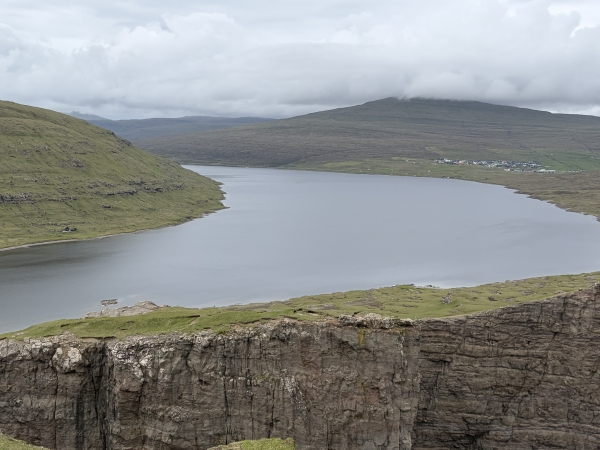
This is the lake on the waterfall visual approach. The runway is hiding around the bend on the left.
Here is a video of the waterfall visual approach to runway 30 at Vagar.
June 11 — Keflavik, Iceland to Vagar, Faroe Islands
The most beautiful approach to an airport
After repositioning to Reykjavik Domestic Airport to buy avgas, which isn’t available at Keflavik, I plotted where I was going to go next. I was thinking Norway, so that I wouldn’t have a very long flight the day before my next race, in Finland. I quickly learned I should have planned earlier. Norwegian airports to which I wanted to fly required slot reservations. And it looked like they closed early, too. (This turned out to be a misreading.)
I finally chose the Faroe Islands, which was my original plan back when I didn’t expect to have spent a night in Iceland. The weather at Vagar was good enough, and the Faroe Islands were someplace I’d never been and very much wanted to go.
It worked out great.
The winds and turbulence at Vagar are notorious, so bad that pilots are required to certify that they have taken an online course that explains the airport’s special system for reporting turbulence and at times closing the airport because of it. But winds were calm on the day I arrived. As I approached the Faroe Islands, the clear skies I’d been flying in turned into marginal conditions for visual flight, with the cloud base dropping to 2,000 feet or lower in places. But I was flying over water (no buildings or mountains).
There is a visual approach to Vagar in which you fly along the shoreline, with cliffs to your left high enough to block your view of anything inland, and then there’s a gap and a waterfall dropping into the ocean, with a lake bent like a boomerang stretching out behind the waterfall. You fly over the waterfall and over the lake, turning left to follow it and avoid hitting the mountains rising on both sides. As you make your way up the lake, the mountain on your left ends, and a runway appears, and you keep turning left and land.
If only I could open my video of this, I would show it to you. I’ll keep trying.
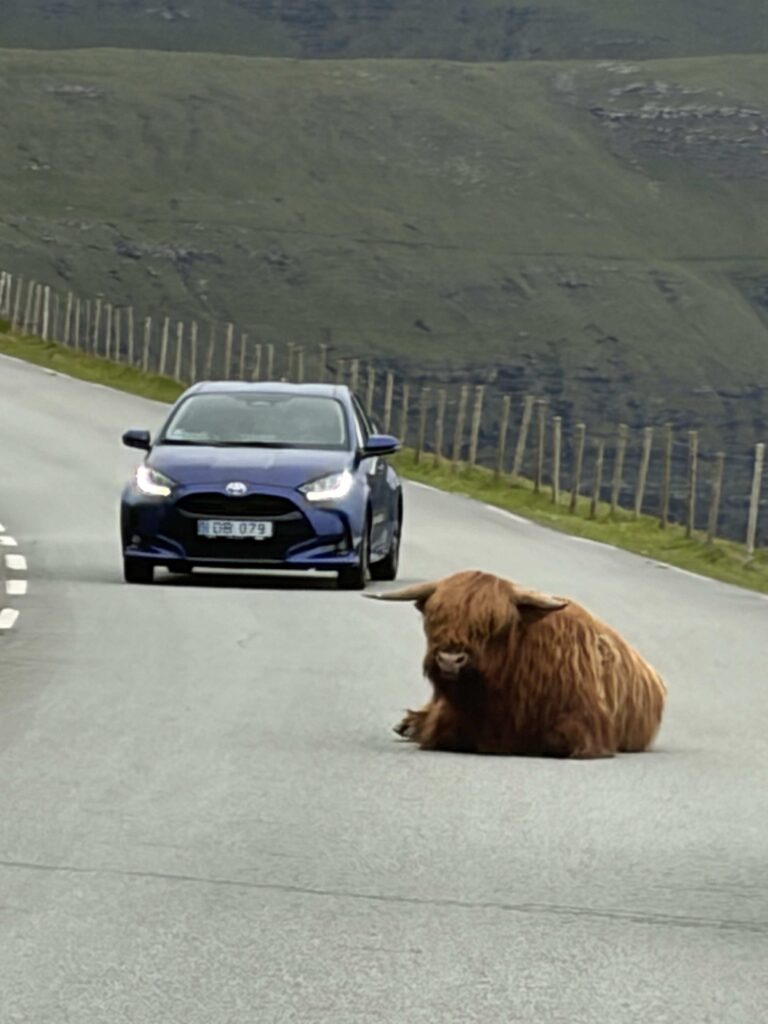
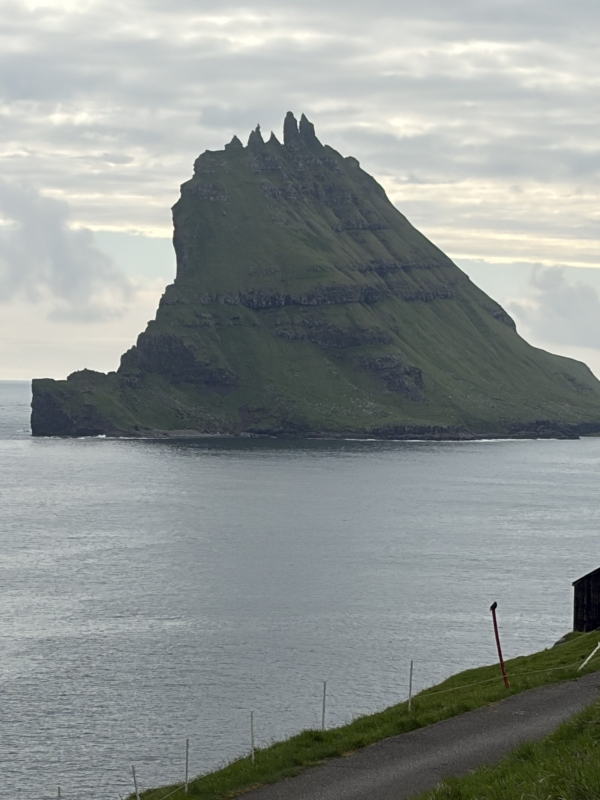
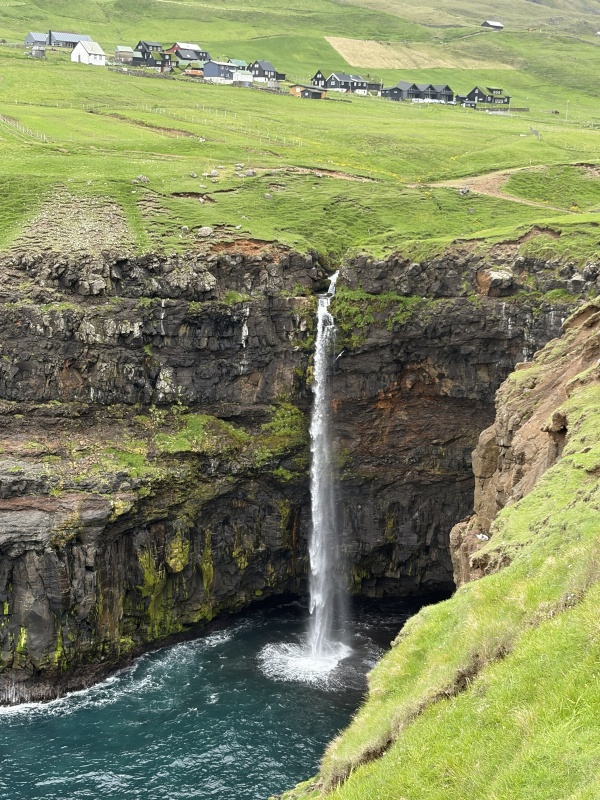
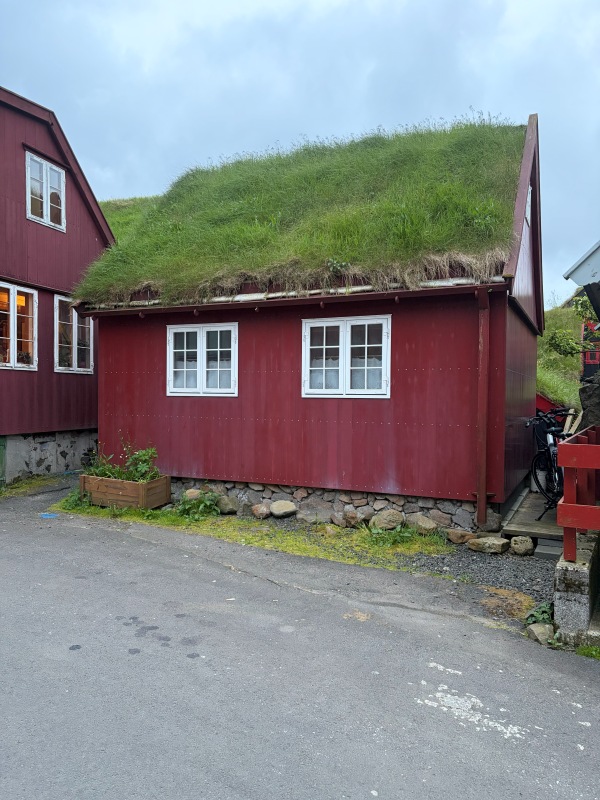
I’ve attached some still pictures that don’t do justice to the beauty I saw in my day in the Faroe Islands.
- June 10
June 10 — Ilulissat, Greenland to Keflavik, Iceland
Flying high over the ice and the icing
Things didn’t look good Wednesday morning. Then, around noon, they improved dramatically. Instead of checking back into my hotel for an additional day, I headed for the airport.
The plan was to fly over the clouds over the ice cap. The weather forecast showed there would be no ice if I got high enough, presumably because I’d be above the tops, but also possibly because it would be too cold for ice to form. Below -15 to -20 degrees Celsius, the moisture in the clouds is already in the form of ice crystals and therefore won’t cling to the airplane’s wings.
Leaving a foreign airport is never as easy as leaving a US one, and though I didn’t have to wait more than an hour to be fueled as I did in Thunder Bay, it took time for the line people to figure out how to plug in their fueling equipment to fuel my plane.
I also had to make a trip to the tower to pay the landing and parking fees. You don’t do this in the United States, but in the rest of the world the people in the control tower act as airport administrators as well as controllers. It’s fun to get to meet them and chat with them, but it does take time, and the fees are often high so the whole thing isn’t as much fun as it would otherwise be.
I can’t blame anybody else for what happened next, though. About 10 minutes after takeoff I realized I had done something stupid. I was planning to fly at 17,000 feet (technically, flight level 170, which is the altitude that would be 17,000 feet if sea level pressure were standard, which is 29.92 inches of mercury), but the air up there is so thin that I needed to breathing more highly concentrated oxygen through a cannula, that two-pronged tube that you’ve seen in hospitals or hospital TV shows. My air compressor and cannula were in the baggage compartment, too far back for me to reach them. So I flew back to Ilulissat, landed, taxied to the ramp, exited the cabin but, without even stepping on the ground, retrieved my oxygen compressor from the baggage compartment, and got back in to re-start the flight.
The rest of the flight went well. The videos below show a couple of the highlights. Over much of the ice cap, there were so many clouds below me I couldn’t see anything. I asked for permission to stop at flight level 160 (about 16,000 feet) to get a bit better performance. The engine, unlike me, can’t breathe compressed air through a cannula, and it starts to figuratively wheeze a bit when it gets up that high.
I had planned to fly to Reykjavik Domestic Airport, which despite its name accepts international flights. It’s a short walk into town and also has a hotel right at the airport, plus it sells avgas. But it closes at 11 p.m., and I was getting in just after midnight, so I had to land at Keflavik, the airport used by the international airliners. A handler gave me a ride to the nearby town of Keflavik so I could check into a hotel.
Here’s what it looks like to fly over the ice fjord leaving Ilulissat headed east over the ice cap.
Flying over the ice cap, the layer of clouds below is the only thing that prevents the surface from being uniformly white; the dark patches you see are shadows from the clouds. In 2003, there was an overcast layer above me, so there were no shadows, and there was no blue sky to form a horizon against the white. Yes, it was more than a bit unnerving.
- June 9
June 9 — In Ilulissat, Greenland
Stuck in heaven
A low pressure system centered just south of Iceland was throwing a wrench in my plans. It was creating a lot of clouds from the center of Greenland all the way to Iceland. It was like a big stop sign for me.
I’m an instrument rated pilot, and with a 100-gallon ferry tank in the back seat I have plenty of range, but my plane can’t handle ice. That means I need to stay clear of clouds when I’m flying at an altitude at or above the freezing level. The part of Greenland’s ice cap I had to cross rises to 9,000 feet, always above the freezing level. So I needed a high level of confidence I could stay below any clouds, or fly in clear skies, or fly above the clouds and descend in clear air on the other side. I kept looking at Windy.com, and the forecasts kept changing, but they never looked good enough. With no airports en route at which to land if things weren’t copacetic, I wasn’t going to launch without a lot of confidence I’d reach Kulusuk (on the east coast of Greenland) or Reykjavik.
But there are worse places to be than Ilulissat. The late-night cruise of the ice fjord is the highlight, but the hiking is extraordinary, too. Danny and I set out in the morning on the yellow trail, so-called because of the yellow circles painted on the rocks at frequent intervals so you can’t really lose your way as you scramble along the shoreline of the bay and the fjord. It was so muddy that one of Danny’s shoes came off, but fortunately he was able to keep his sock out of the mud while I retrieved the shoe. Here’s a photo from the hike.
In the afternoon/evening, we took a cruise one hour north to a small settlement to witness what life is like in rural Greenland. Isolated, beautifully isolated.
Danny had a Thursday flight to catch from Reykjavik to New York, so we decided he would fly commercial to Reykjavik on Wednesday. That took the pressure off of me to get him there, and it also allowed me to substitute his weight (and the weight of his baggage) with more fuel, which gave me more options to turn around or divert if necessary. I figured I probably wouldn’t get to Reykjavik until Thursday, if then.
Flight tracking apps showed that Mike, the ferry pilot, was still in Kangerlussuaq, waiting out the weather, too.
- june 8
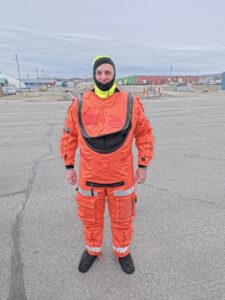
Danny in his immersion suit June 8 — Iqaluit, Nunavut to Ilulissat, Greenland
The crossing begins
Ferry pilots (people who deliver airplanes) fly from Iqaluit to Kangerlussuaq, which is what I did when I flew to Europe from Atlanta in 2003. It’s the shortest distance across on the northern route to Europe (as opposed to the route from Goose Bay to southern Greenland). But I was fortunate enough to talk to an Air Greenland pilot after landing in Kangerlussuaq in 2003, and he told me that one hour north of there I would find one of the wonders of the world, the ice fjord at Ilulissat. It was the highlight of my trip. This time, I skipped Kangerlussuaq entirely and headed straight toward the iceberg paradise.
We donned our immersion suits (which are to keep you warm enough to get into your raft; the water is so cold that hypothermia would otherwise make your muscles incapable of that job). Danny had rented a fitted one; I own a far bulkier generic one that makes me look like an orange Gumby.
Hans, the Danish ferry pilot who was ferrying the turbo Cirrus we first saw in Thunder Bay, had engine problems and was going to fly home via airlines because getting a mechanic to Iqaluit and fixing the problem could take more than a week. You don’t want to cross if there’s anything wrong. My friend Janice Ribaudo, who parked her turbo Mooney two spots from mine at Santa Monica Airport, has a great video of experiencing engine trouble between Canada and Greenland. I didn’t want a similar experience.
So when I thought the engine was slow to get going on the takeoff roll and running a bit rough when it did get going, I aborted the takeoff roll and taxied back to the ramp for some diagnosing. My brother got out. I restarted the engine, waited for an airplane to land, then did a high-speed taxi to see if things were normal. All went well, so I taxied back, my brother got in, and off we went.
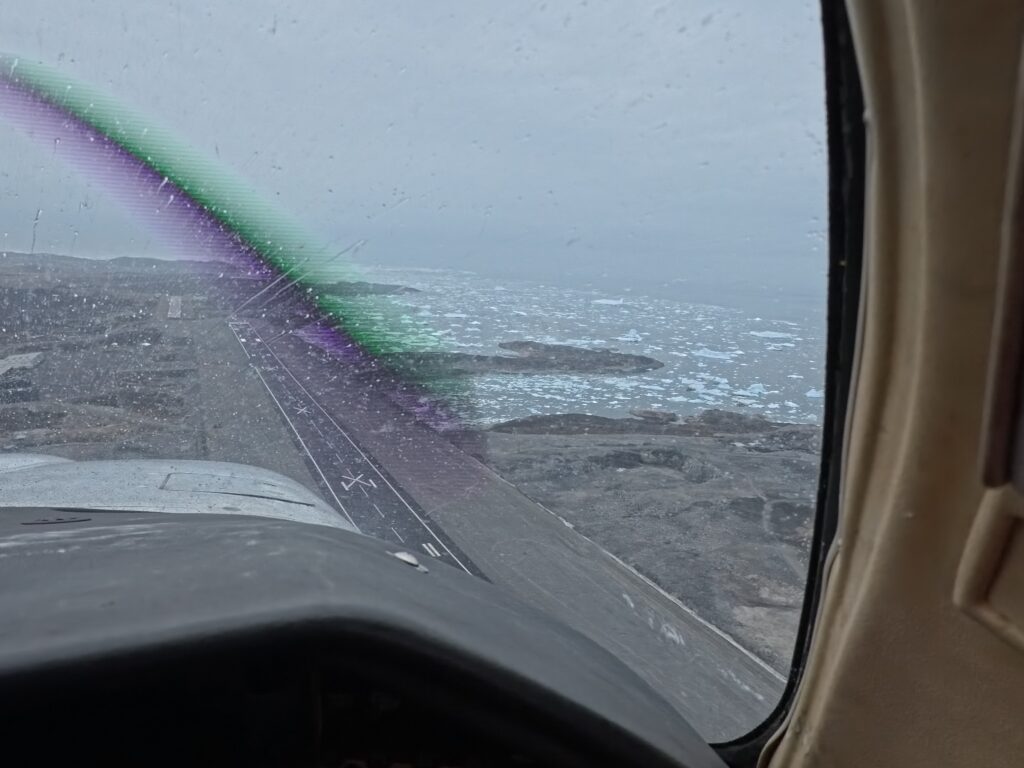
Short final at Iqaluit in light rain. The small runway at top left is where we’re going. The big runway below will open later in 2026. We got brief peeks of Baffin Island and then the water, but most of our almost four-hour flight was in or above clouds, but safely at an altitude with above-freezing temperatures so no ice on our wings.
Ilulissat was as glorious as I remembered it. We took a late-night cruise among mountainous icebergs, followed by a day hiking along the ice fjord, and we took a lot of pictures, none of which capture the icebergs’ size, beauty, colors, and dramatic effect. My pilot friend Joan Carroll took much better photos than mine in August 2025.
- June 7
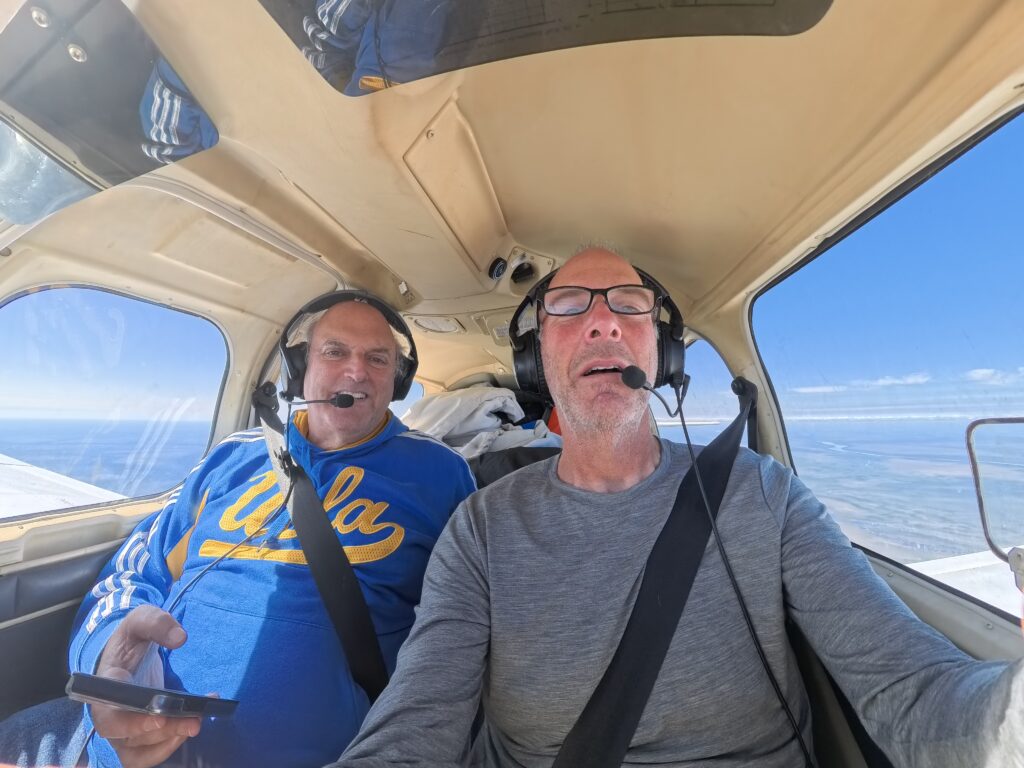
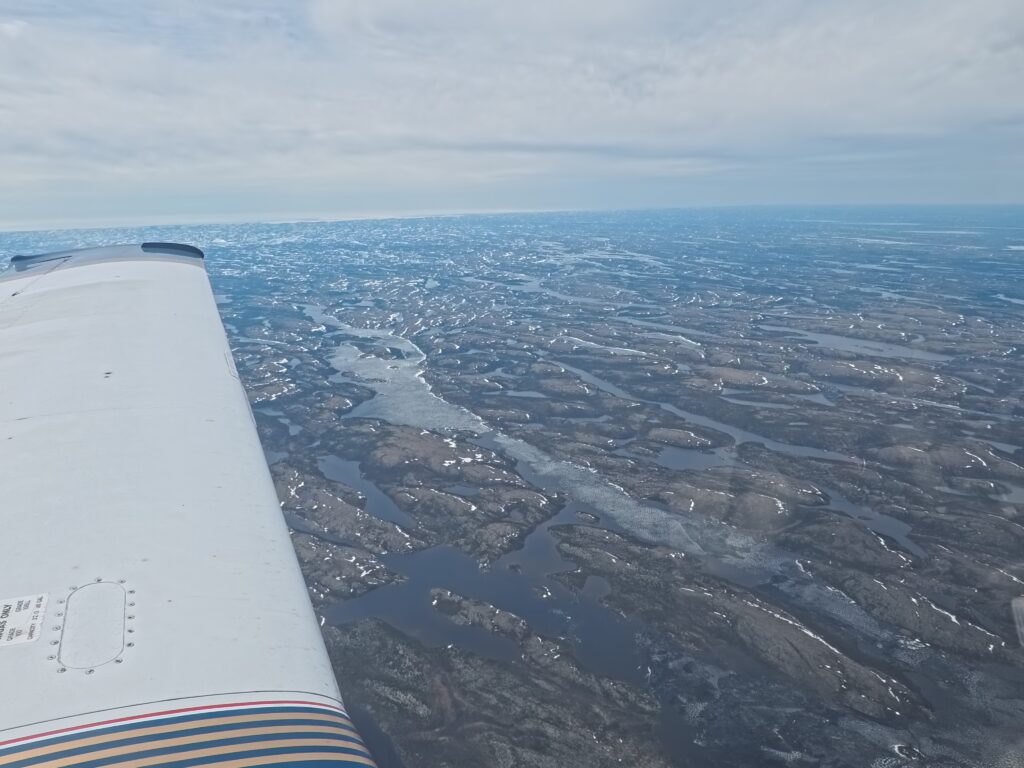
Northern Quebec looks like this for miles and miles and miles and miles and . . . 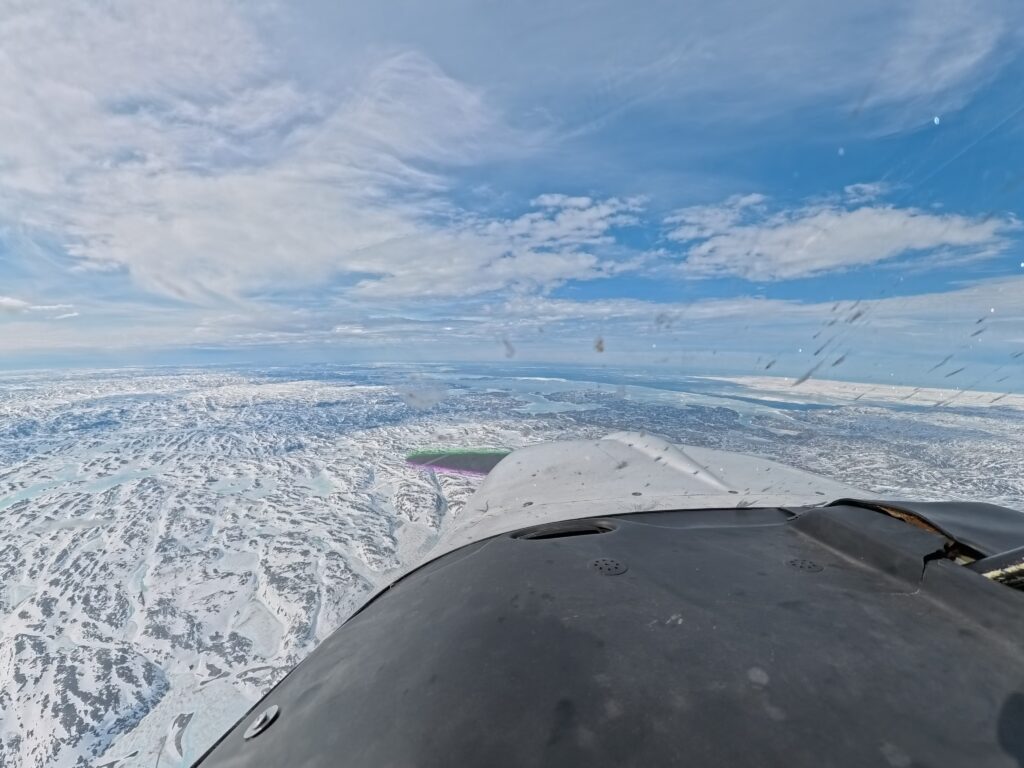
June 7 — Thunder Bay, Ontario to Iqaluit, Nunavut
North, to the arctic
We got a taxi to the airport at 7 and then had an hour-long wait to get our plane fueled. We should have had that done when we arrived the night before. We finally launched into mostly clear skies at 9:17. It took a while for air traffic control to see our transponder (which identifies my plane on the radar screen), but just as I was wondering whether I’d have a problem to solve they spotted us.
We crossed the southern part of Hudson Bay, and much of it was ice. At 7,000 feet, we were within glide range of land for all but a short portion of the crossing, but I did think about whether the ice was thick enough to support my plane if the engine failed and I needed to land.
There was not much else to see en route, other than the vast expanse of uninhabited Canada, which I think you cannot fully appreciate until you have experienced traveling through it, mile after mile, hour after hour, with no manmade object in site, no radar contact with air traffic control, and gaps when you can’t reach a controller by radio, either. You’re very much alone with your airplane, relying on it to keep functioning long enough to reconnect you with the rest of the world. These are the moments when you’re grateful for your mechanic and their skill in maintaining the plane that is keeping you airborne when there’s nobody in sight and nobody within earshot of your radios.
As we neared our fuel stop at La Grande Riviere, we saw another plane on our avionics displays through a technology known as ADSB; it was approaching from our right and was going to beat us to the field. When we landed we saw the blue Cirrus at the fuel pump. It was a new plane being ferried from Knoxville to Berlin by Mike, a ferry pilot from Oklahoma who has, we were later told, more than 600 North Atlantic crossings under his belt. He, too, was headed for Iqaluit.
We finished our eight-hour flying day by crossing over the Hudson Strait and the southern part of Baffin Island to reach Iqaluit, the capital of Nunavut, a town of about 7000. It is spelled ᐃᖃᓗᐃᑦ in Inuktitut. The buildings are on stilts; otherwise, the heat from the buildings would melt the permafrost and destabilize the foundations. The airport has avgas by 55-gallon drum; the fuel that wouldn’t fit in my wing tanks went into my ferry tank, and the man pumping the fuel knew how to do that without spilling it, because he had fueled many a ferry tank before. People needing avgas don’t generally go to Iqaluit unless they’re making the long journey across to Europe.
- June 6
June 6 — Jackson, Wyoming to Thunder Bay, Ontario
Goodbye, USA; see you in 2027
I began the day by calling Canadian immigration to let them know we were on our way. It was a beautiful morning as we drove out of Jackson toward the airport, and then Danny asked me if I had his passport. I didn’t. A quick call to Rick confirmed that I had left it on the desk at Michael Solomon’s house after reading the passport number to Canadian immigration. Fortunately, Danny caught this not only before takeoff but before we returned the rental car. I got a second chance to say goodbye to the Clevelands, and we drove off again. You can read Rick’s story about my adventure here.
We had woken up early to take advantage of the lower winds and lighter turbulence of the morning, but that plan still didn’t prevent us from hitting a couple of very big bumps between Jackson and Thermopolis, where I had planned to stop for fuel. Because of those bumps, I decided it was wiser to fly further before stopping, and we set out for Ekalaka, Montana, near the South Dakota border, where self-serve fuel was available.
Unfortunately, although I could hear the fuel pump start, I couldn’t get any fuel when I squeezed the handle. The only plus was Danny got to set foot in Montana for the first time. The only other state in the contiguous United States Danny hadn’t been to was South Dakota. So when we took off again for the closest airport with fuel, in Buffalo, South Dakota, we completed his set.
Danny spotted a rodeo as we were on final approach for runway 12. When we landed, I saw a lock around the fuel hose handle; the avgas wasn’t self-serve, and there was no one around to fuel us. The good news was that we were safely on the ground. The bad news was that we now didn’t have enough fuel to launch again in search of self-serve.
A little building near the fuel pumps has a bathroom and also serves as a pilot lounge. There was a number to call for fuel. We called it, and the woman at the other end said she would call the owner and get somebody to come fuel us. Within a half-hour, a very friendly woman arrived with the key to the pump, and we were in business. We topped off, and she gave us a ride into town to pay at the local gas station. On the way back to the airport, we asked her to drop us off at the rodeo. It was a high school rodeo, with free admission, and concession stands where we could get lunch and smoothies. We saw some saddle bronc riding and some calf roping, experiencing the sort of serendipitous afternoon that is one of the best things about flying your own plane.
Tower, Minnesota, was our final US fuel stop, chosen for its location near Canada and its avgas price of less than $5 per gallon. It would be a very long time before gas that cheap was available to me again. On takeoff from Tower, I needed to activate my flight plan for the border crossing into Canada, but I couldn’t get through to Princeton Radio. Minneapolis Center suggested another frequency to try, and though there was static, that seemed to do the trick. We got a handoff to Winnipeg Center near the border, then had a smooth flight into Thunder Bay.
As usual, immigration control into Canada was smooth and easy. I made a phone call after landing and was given a number to write down, and we were admitted into Canada. We parked on the ramp next to a Cirrus, the only other small plane in sight. It was 9:13 p.m., and the fixed base operator (place where you park your plane when you’re traveling) was officially closing, but the guy was sticking around anyway for a late-arriving flight so was not in a hurry to shoo us out of the building. There was a long wait time for the Uber, so we walked to our hotel (40 minutes). Dinner was a collection of appetizers and some local beer as we watched the Stanley Cup Finals, the obvious thing to do on an early June night in Canada. When we started watching, Las Vegas had a four-goal lead in the third period. Minutes later, the game was tied. It went two overtimes before Las Vegas finally won it.
- June 5
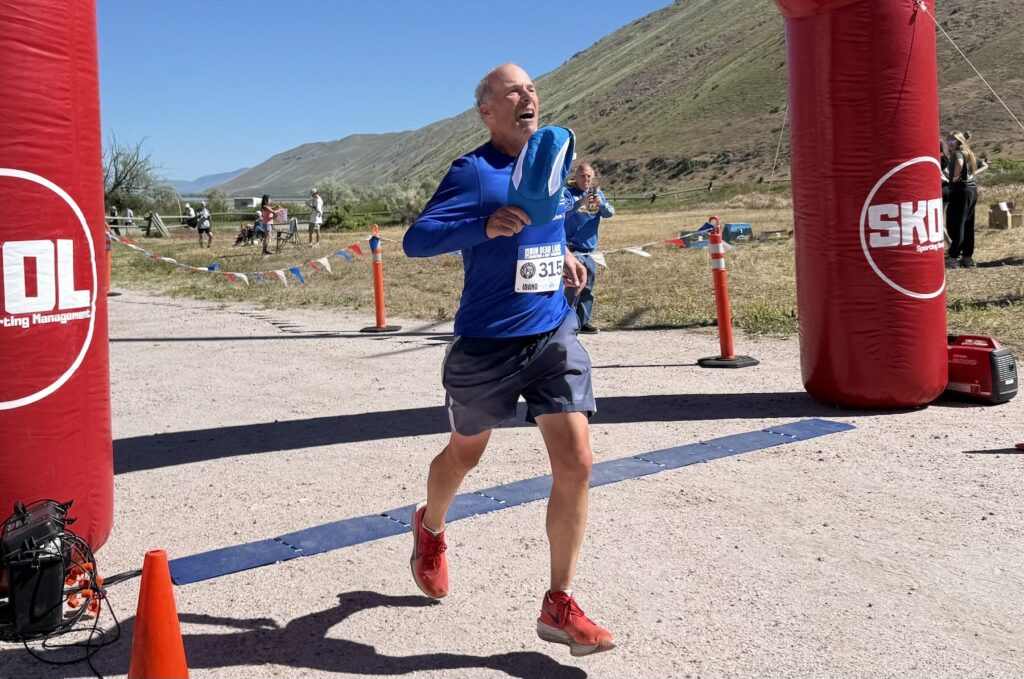
Tyler Cleveland’s photo of me crossing the finish line, with my brother cheering in the background.
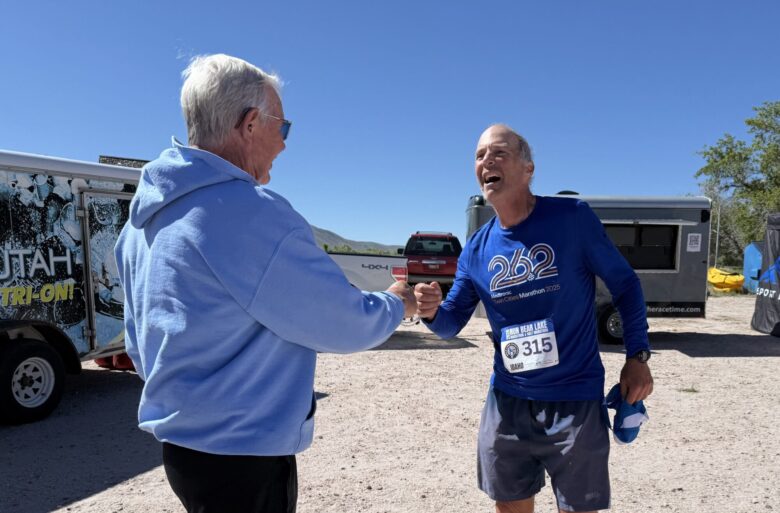
Tyler Cleveland’s photo of me celebrating with his dad, Rick.
June 5, 2026 — The Bear Lake Idaho Marathon
My 50th marathon state!
The race started at 6:30. I woke up before 4 and wasn’t going to get any more sleep. I drove to the start line, about 30 minutes away, and tried to sleep there before race number pickup opened at 6. I had arrived too late on Thursday to pick up my number then, but there was little stress because the field was small, meaning there wouldn’t be a line. While walking to a porta potty, I stepped through a gap in a cattle grid, and my size 14 foot didn’t immediately want to make it back up to the surface. Fortunately, I didn’t sprain anything, and I managed to extricate myself.
It was supposed to be about 40 degrees at the start, so I wore a long-sleeve shirt. Choosing the right clothes for a marathon typically is a compromise between feeling good at the start, when the weather is cool and you haven’t warmed up from running, and feeling good at the finish, when the weather is warmer and you’ve been generating heat from running. A few minutes into the race I was wishing I had chosen short sleeves, but the temperature didn’t heat up too much and things turned out OK.
I had been warned that the course was hilly, and I knew it was at 6000 feet elevation, so I was expecting this to be the most challenging road race of my 26 marathons. My goal for my road races on this trip was to finish in less than 4 hours, which is a 9 minute, 9-second pace per mile. I started too fast and was running in the 8:30s. I eased off the pace in time, though, and enjoyed the gorgeous views of Bear Lake on my right. The travel marketers call it the Caribbean of the Rockies because of its turquoise color.
The Bear Lake Idaho Marathon is part of a three-marathons-in-three-days series, so a lot of the other runners were on their second race in two days. People collecting states come from all over. I met a guy from Iowa and a couple from New Jersey (she was running the full marathon, and he was running the half), along with some guys from Utah. Talking briefly with other runners is not unusual in a marathon; I wanted to be running a pace where that was possible, because if I’m working so hard I can’t talk I’m not going to be able to sustain the pace for 26 miles.
As it turned out, I couldn’t sustain my pace for 26 miles, anyway. A couple of the hills at the end were too much for me, and I walked them. But I reached the finish line in 3:56:30, placing 11th overall and fastest among runners 50 and over. Best of all, my brother and the Clevelands were there to celebrate with me.
I was very happy but also very much in a hurry. Check out time at the hotel was 11, and I left quickly to grab a much-needed shower and check out. The Clevelands were kind enough to stay behind to pick up my medal for winning the 60-69-year-old men age group. For lunch, my brother and I each enjoyed a huckleberry milkshake, a regional specialty I’d fallen in love with on an earlier visit to eastern Idaho. Get one yourself from Papa’s Chocolates, across the street from the LDS Temple in Montpelier, and tell them I sent you.
We drove back to Logan, dropped off the car, and took off for Jackson, Wyoming. Temperatures were high, meaning the plane performed poorly. The concept of “density altitude” is important for pilots; that’s essentially the altitude that the engine thinks it is at, based on conditions. Our anemic climbout was followed by some bumps as we wound through the mountains.
At Jackson, another challenge awaited us in the form of a strong, gusty crosswind. The recorded weather at Jackson (technically, the “automatic terminal information service,” or ATIS) warns that planes that don’t touch down in the first third of the runway risk overrunning it. When landing with gusts, pilots carry a bit of extra speed. I carried a bit too much, and we floated in what’s known as ground effect, the added lift created by the wings being close to the ground, using up runway. I was ready to go around (abort the landing by adding power and taking off) but managed to save the landing, which wasn’t elegant but was safe. The Clevelands, my brother and I then had the pleasure of staying at the house of good friend and former colleague Michael Solomon. I got a very good night’s sleep.
- June 4
June 4, 2026 — Santa Monica, California to Montpelier, Idaho
The adventure begins
The trip I had been planning for years began after a few hectic days of moving out of my apartment and getting my belongings into storage. This involved an all-nighter that ended with me sleeping from 6 p.m. Wednesday to 4 a.m. Thursday, after which I got up and packed the rest of my belongings. It took two trips in a Zipcar and a lot of help from my brother Danny, but everything fit in my parents’ garage. We had to say quick farewellls to my parents to get the Zipcar back in time, then took an Uber to the airport. We launched at 1:05 p.m., five hours later than I had planned, but I was relieved.
We had plenty of time to fly to Logan, Utah, and drive to Montpelier, Idaho, and the cost of the late start was merely some light to moderate turbulence. Turbulence of that kind generally isn’t dangerous, but it can be unnerving. My brother handled it like a pro, partly because my new Starlink kept him entertained listening to baseball games and browsing the Web. I had purchased a gadget to suction cup the Starlink mini to a side window. A day before the flight, I had tested it and couldn’t get it to work. Turns out, having it sitting on the dash on the copilot side worked fine.
Our routing took us past the Hollywood sign, which was not all that easy to see in the LA haze, then just north of Pomona before crossing the Cajon Pass toward Apple Valley, Hector, and over Las Vegas, where controllers asked us to divert to the east to avoid conflicts with departing airliners. Soon we were back on course toward Provo. Just before Provo, we turned left and headed up the valley, hugging the west edge of the Wasatch Mountains. Visibility was terrific as we flew just east of Salt Lake City and the Utah State Capitol.
We cut east through Weber Canyon north of Ogden and had an easy and smooth descent into Logan, where the line service was exceptional. They tied down our plane and drove the rental car up to us, and we were headed north in no time. The drive was scenic, through narrow mountain passes, and we reached Montpelier in about 90 minutes. Awaiting us were Rick and Liz Cleveland and their adult children, Tyler and Annie, decades-long friends of mine from Jackson, Mississippi. Rick had told me a few years earlier that he would come to see me run the marathon that completed my 50 states, and not only was he true to his word but I got the bonus of seeing the whole family. The pesto pasta dinner at Rooster’s Grazing was perfect for carb loading.